
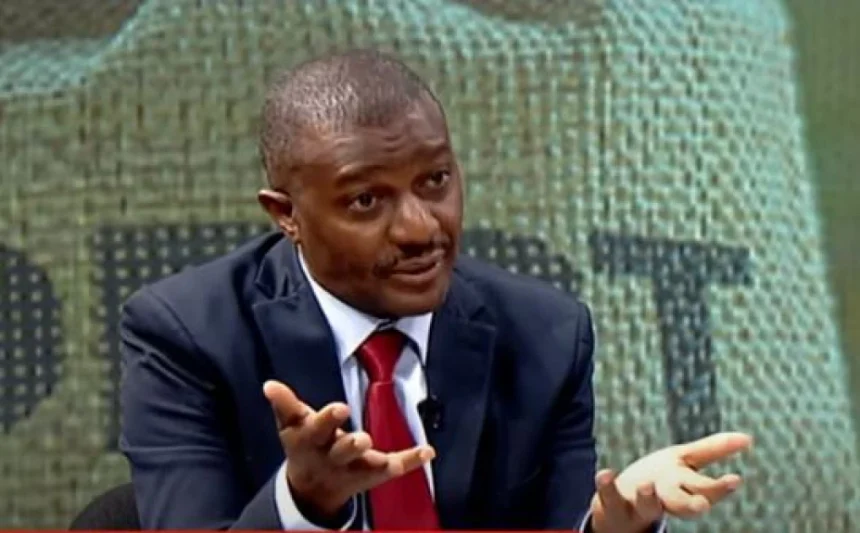
Speaking to Citizen TV on Thursday, Senator Maanzo alleged that he was approached by ‘Kenya Kwanza operatives’ who offered Ksh.10 million to vote out Gachagua.
He intimated that operatives close to President William Ruto threatened dire ramifications if he chose to take the bribe and not honour their demands, therefore rejected it.
“I was approached on a condition that I take money and vote YES and that if I take it and vote NO I will not get to my house. It was Ksh.10 million from government agents,” Maanzo noted.
“They are not in the House, but they are people who have been in politics for a long time, Kenya Kwanza operatives close to the President.”
His sentiments come hot on the heels of a series of bribery confessions from elected Members of Parliament who openly noted that money exchanged hands to effect Gachagua’s ouster.
National Assembly Minority Leader and Suna East Member of Parliament (MP) Junet Mohammed confessed to bribery in both the National Assembly and the Senate, which overwhelmingly voted in support of the impeachment motion.
According to Junet, Kericho Senator Aaron Cheruiyot was the custodian of the money that was dished to Members of Parliament.
“Wakati tulikuwa tunafukuza Gachagua kazi, kuna kitu ilitembea hapo. Huko Bunge. Accounting officer alikuwa Aaron Cheruiyot,” he said during a convention by the United Democratic Alliance (UDA) and the Orange Democratic Movement (ODM), held in Kakamega on July 26.
His comment was echoed by Lang’ata MP Felix Odiwuor, widely known as Jalang’o, who claimed that politicians received bribes of different amounts to impeach the ex-DP.
“Watu walikula, watu walifurahia. Ilikuwa inadepend unamwongelesha nani na saa ngapi. Bila kutaja ilikuwa ngapi kuna watu walikula mingi, wachache. Minority leader ashasema pesa ilikuwepo. Watu walikula,” he said on Alex Mwakideu’s podcast AMTV.
Gachagua, now the Democracy for the Citizens Party (DCP) leader and a formidable opposition figure, has demanded action from the Judiciary to deliver justice.
“We are asking our courts and our judges to take Judicial notice of what these people are saying. If they are confessing in public they were bribed then the judges must dispense justice. It is what we have always known,” said Gachagua during consultations with a party delegation from Nyeri on Wednesday.
Return to court?
This comes after Gachagua suffered a major legal setback on June 8, after the High Court dismissed his petition challenging the impeachment.
The High Court further ordered the Senate to pay him Ksh.50 million in constitutional damages for violating his right to a fair trial during his impeachment process, an amount he rejected, terming it a mockery of his fundamental rights and the Constitution.
Justices Eric Ogolla, Anthony Mrima and Frida Mugambi rejected the key arguments advanced by Gachagua and upheld the impeachment process conducted by Parliament.
Gachagua argued that Parliament rushed the process and that the Senate infringed on his constitutional right to a fair hearing by refusing an adjournment when he fell ill during the trial.
He also argued that the 11-count impeachment motion—which included allegations of corruption, abuse of office, and ethnic division—was a fabricated political tool rather than legitimate constitutional grounds for removal.
His legal team also held that presiding officers, MPs and Senators showed pre-determined bias and conflict of interest against him during the ouster proceedings.
Prominent legal minds expressed dissatisfaction with the ruling by the three-judge bench, terming it dangerous.
Former Chief Justice David Maraga believes that the ruling will open the door to repeated legal breaches in impeachment cases.
According to Maraga, the judgement had discrepancies after finding that Gachagua’s right to a fair hearing was violated, yet he was awarded Ksh.50 million in compensation instead of nullifying the impeachment.
Lawyer Donald Kipkorir termed the High Court decision a “Judicial absurdity” or a Reductio ad absurdum.
“Constitutional Division of our High Court holds that the Constitutional Rights of Gachagua were violated but proceeds to compensate him for the violation instead of annulling the process,” he argued.
He likened it to a ‘Cheptongei Village Tribunal judgement’ where: “We agree with you that your neighour cut your fence & stole your cow. We can see the cow in its compound. But we are afraid we can’t return the cow as he has fixed the fence where he had cut. But to compensate you, we will give you a goat!”
Former Law Society of Kenya (LSK) President Faith Odhiambo opined that the ruling calls for keen reflection on the coherence of Kenya’s remedial framework.
“The question that naturally follows is whether that infirmity was capable of tainting the entire removal process. The right to a fair hearing is not a procedural decoration,” Odhiambo argued.
Odhiambo held that the ruling on Gachagua’s case may establish leeway for the Senate and the National Assembly to not face the repercussions of their mandates “if a constitutional violation during impeachment proceedings can be remedied by damages without disturbing the outcome”.