

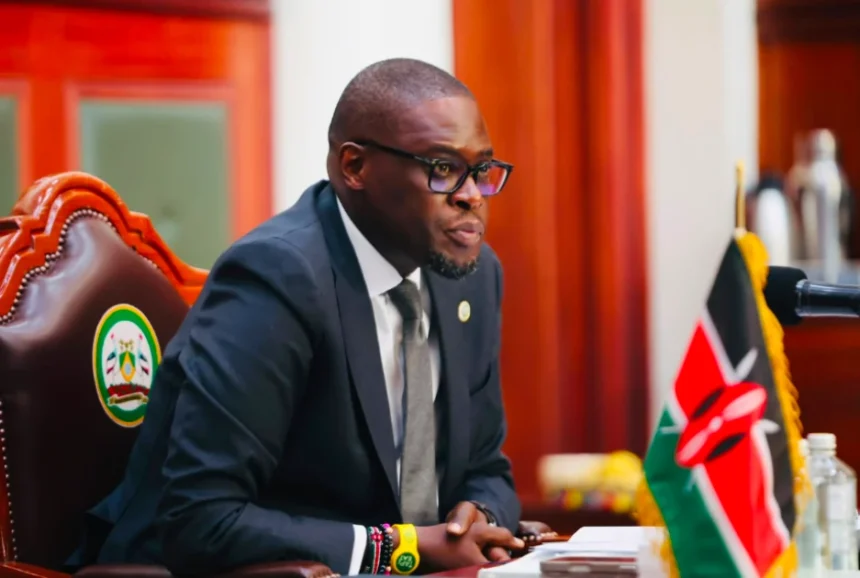
Appearing before the Senate County Public Investments and Special Funds Committee (CPISFC), Sakaja said the county had written several letters to national government ministries that had failed to honour their rates obligations.
He told Senators that the Ksh.2.7 billion figure relates to outstanding rates owed by ministries, while other public institutions, including police stations, prisons and military barracks, have significantly larger outstanding obligations.
Sakaja said Nairobi has the potential to raise Ksh.80 billion in own-source revenue if land rates are fully collected, arguing that improved revenue collection would give the county greater capacity to finance essential services and development projects.
To boost collections, the Nairobi Revenue Authority (NRA) has appointed six specialised debt recovery firms, with each expected to oversee recoveries within one of Nairobi’s six boroughs.
The firms will target long-standing land rates arrears, including accumulated penalties and interest.
Defending the county’s revenue reforms, Sakaja said the NRA had been fully established within the law and had helped digitise the collection of 125 revenue streams.
He said the reforms had simplified the process of doing business in Nairobi, including the introduction of a single business permit that can be applied for, paid for and printed online without residents having to visit City Hall.
“There is no cash payment, and all these are under the NRA. We have been able to raise revenue from Ksh.8 billion to Ksh.15.4 billion in four years,” Sakaja said.
The Governor also pointed to the National Rating Act, 2024, which was assented to by President William Ruto in December 2024, as a key piece of legislation that could strengthen Nairobi’s revenue base when fully implemented.
However, Sakaja proposed a negotiated approach to resolving the outstanding debts between the county and national government institutions, saying there was a need to establish a clear framework on what each side owes the other.
“The conclusion of the matter is having a meeting with the Head of Public Service at State House, where we see how these monies can be paid, what we as the country owe them and what they owe us, so that we have a well-discussed and agreed way of settling the matter,” Sakaja said.
The committee chair, Taita Taveta Senator Johnes Mwaruma, reiterated the need to summon the relevant institutions before the committee to address the matter and find a lasting solution to the outstanding rates issue.
Sakaja said increased compliance among property owners was critical if Nairobi was to achieve the level of development associated with global cities such as Paris.
“For this city to be in the same place as Paris, we need to pay what is needed to the county in land rates. For long, we have been carried on the shoulders of mama mboga,” Sakaja said.
He argued that the burden of financing Nairobi’s services should not continue to fall disproportionately on small-scale traders and ordinary residents, while major property owners and institutions accumulate large rates arrears.
The Governor’s appearance before the Senate comes as Nairobi steps up efforts to widen its revenue base and recover billions of shillings in unpaid rates, with the county banking on stronger enforcement, digitisation and improved compliance to fund better services and infrastructure across the capital.