

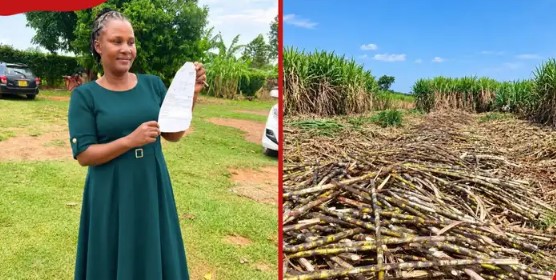
Redempter Makokha had very little when she returned to her father’s home in Mumias, Kakamega County. Her marriage was over, she had no income, and she was responsible for five children.
What she found waiting for her, however, was half an acre of land and a conditional offer from her father: work hard. That single instruction set the course of the next two decades.
From One Harvest to a Farming Enterprise
Makokha began tending to the sugarcane already growing on the plot. She had no formal schooling to fall back on and no savings to cushion her.
Her first harvest gave her KSh 26,000. Rather than using it to cover household expenses, she channelled it into leasing additional land, treating the money as capital rather than income.
That decision, made quietly on a small farm in western Kenya, became the foundation of everything that followed. Over time, the operation grew steadily. By reinvesting earnings season after season, Makokha expanded her holdings from that original half acre to more than 106 acres of sugarcane plantations.
She acquired two tractors for land preparation and transport, constructed a six-bedroom house, and funded her children’s education entirely from the proceeds of her farming.
Seven Years of Difficulty
One of her daughters eventually travelled to the UK for further studies, a journey partly supported by Makokha’s farm income.
Her path was far from smooth. The extended closure of Mumias Sugar Company plunged the region’s farming community into uncertainty.
For more than seven years, Makokha struggled to find a reliable market, trying other factories where she said payments were considerably lower.
At one point, sugarcane rotted in her fields while her earnings shrank, but she refused to abandon the crop.
A New Beginning
When Mumias Sugar Company resumed operations in 2021, she moved quickly to restore her supply relationship with the factory.
Her patience eventually yielded a bonus payment of KSh 317,000 in 2023 and 2024 combined. The amount caught her off guard.
“When the money was deposited, I had to double-check if it was real,” she said, adding that she celebrated briefly with close friends before redirecting the funds towards school fees and her daughter’s travel costs to the UK.
Makokha’s story carries particular weight because she entered sugarcane farming at a time when it was widely considered a male domain in her community.
Her two tractors, her house and the education her children received all trace back to that first harvest and the choice she made with it.
For many women in similar circumstances, her journey offers a straightforward but powerful point: the size of the beginning matters far less than what is done with it.