

Children’s homes run on a fragile fuel: other people’s generosity.
That fuel runs out. Not because anyone stops caring, but because caring has a shelf life — the same appeal that moved someone last year barely registers this year. When it dries up, the money dries up with it. Underneath that is the real problem: most children’s homes have no income of their own.
Their whole budget rises and falls with whoever happens to be paying attention this month. Pull one donor out, and there’s nothing underneath to catch it. Meals shrink. Staff cut corners. Decisions about a child’s wellbeing quietly become decisions about what the budget can survive.
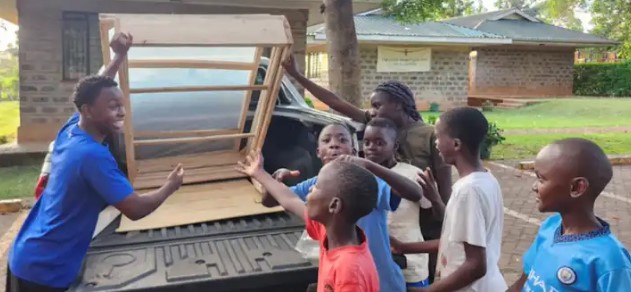
At a children’s home in Nairobi, a group of teenagers are changing that equation themselves. They’re slicing tomatoes and loading them onto wooden trays inside a homemade box. Sunlight pours through a gap at the top. No electricity. No moving parts. Just a solar dehydrator they designed and built for about $85, drying produce that will later sell at a weekend market.
The idea behind it is bigger than the machine itself: what if young people in children’s homes didn’t have to wait for the next donor, because they’d already built what they needed themselves?
That question drives Kurelent, a youth-led initiative founded by 18-year-old Kwame Mureithi. It tackles donor dependence head-on ,not by chasing more donors, but by equipping young people with the skills to design, build, and run their own income-generating enterprises.
For many homes, the cycle is familiar. Money is needed. Someone raises it. The money is spent. Then the fundraising starts again. When donors leave or contributions slow, the expenses don’t. Food still has to be bought. Electricity still has to be paid. School supplies still have to be purchased.
Mureithi’s answer isn’t more donors. It’s giving young people the tools to need fewer of them.
Start with what’s already there
Kurelent doesn’t arrive with a business plan. There’s no catalogue pushing homes toward soap-making or vegetable gardens. Instead, the process begins with one question, asked directly to the young people who live there: What do you already have?
Land. Tools. A garden. Unused materials. A skill. Foot traffic outside the gate, something everyone else has stopped noticing. The young people spot the opportunity; Kurelent works alongside them, testing ideas and supplying the engineering support to turn them into something real.
“When we started, the first question wasn’t, ‘What do you need?'” Mureithi says. “It was, ‘What do you already have that nobody’s using?'”
That distinction is the entire model. Mureithi isn’t building enterprises for children’s homes he’s building young people’s capacity to create enterprises themselves.
“We don’t want a child pointing at something and saying, ‘Kurelent built that for us,'” he says. “We want them to say, ‘We built this.'”
At Kings Village Children’s Home, the answer was sitting in the garden. And sometimes rotting there.
A tomato becomes a business
Kings Village grows tomatoes, bananas, and vegetables to help feed the children who live there — but harvests never quite matched consumption, and fresh produce kept spoiling. During Kurelent’s first design sessions, the young people started looking at that waste differently: could they preserve it long enough to sell?

Their answer was sunlight. Working with Kurelent, they sketched designs, measured the available space, and began building a solar dehydrator — a chamber using heat and controlled airflow to draw moisture out of fruit and vegetables. No electricity. No industrial machinery. Just an engineering problem, solved with what was on hand.
The original design called for an insulated metal chamber, food-safe mesh trays, and a polycarbonate cover. Once the team priced the materials, the plan changed fast: the mesh alone threatened to swallow a quarter of the budget, and the polycarbonate was priced for commercial construction. Mureithi refused to solve that by simply spending more.
“If we built something the home couldn’t afford to repair without us, then we hadn’t made them more independent,” he says. “We’d just created another dependency.”
So they redesigned it. Metal became local timber. Commercial trays became removable wooden frames. Then they tested it, and the airflow was off — produce on top dried faster than food below. Back to the drawing board: new vents, adjusted spacing, reflective lining. Test. Adjust. Test again.
By the fourth iteration, the dehydrator was drying produce consistently enough to sell — and the build cost had dropped from around $150 to $85. The failures hadn’t just produced a better machine. They’d produced a cheaper, more replicable one, built entirely by the young people who’d use it
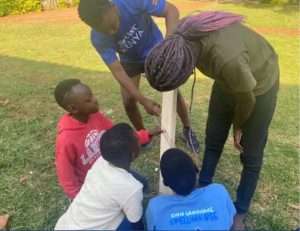
“The moment it actually worked we literally screamed. Like actually screamed. We ran to go get everyone,” one of the teenagers who helped grow the tomatoes remembers.

More Than a Machine
For Mureithi, a prototype that works isn’t the finish line. “The dehydrator isn’t Kurelent,” he says. “The process that produced the dehydrator is Kurelent.”
That’s why the ambition was never to mass-produce identical dehydrators across every home Kurelent works with. The goal is to pass on the same way of thinking that created Kings Village’s — spotting an overlooked resource, sketching a rough solution, failing at it, and rebuilding until it holds — so the model travels even when the machine itself doesn’t.
The Bigger Idea Hiding Inside Kurelent
Mureithi has spent the past four years building things alongside teenagers, not for them. He’s worked with more than 3,000 young people across Kenya, Israel, China, and the United States. In Kenya, he partnered with STEAMLabs Africa to build a dedicated STEAM lab at Rusinga Schools, backed by roughly $10,000 in fundraising. Kurelent’s enterprise model — entered under the name Second Harvest — later won a $2,000 UWC Go Make a Difference grant.
But Mureithi has grown wary of the number most youth organizations love to advertise: people reached. Reach is easy to count. What’s left behind after you leave is the real measure — so Kurelent tracks it directly. Is the enterprise still operating? Are people still buying? How much has it earned? Could the young people who built it design another one on their own?
Taking the Model to Israel
Kurelent had already proven itself in Kenya. The real test was whether the same process would hold up somewhere entirely different — new country, new resources, new young people leading it.
That test came when Mureithi moved to Israel to attend high school. He brought the same question with him: what do you already have?
At a children’s home there, the answer wasn’t a garden — it was empty space. A flat rooftop that caught sun most of the day and did nothing but collect old furniture and dust. No soil. No land to farm. Nothing that looked like a resource to anyone who walked past it.
Working with the teenagers there, Mureithi helped them design a hydroponic system — plants grown in nutrient-rich water instead of soil, stacked in vertical towers to make the most of a small footprint. The first build ran on a single pump cycling water continuously through six towers. Within two weeks, half the seedlings had yellowed: water wasn’t reaching the top trays evenly, and the roots at the bottom were sitting too long and starting to rot.
So they rebuilt it. The pump went on a timer instead of running constantly, the pipe angle was steepened so water drained faster, and the number of towers dropped from six to four to keep the system easier to balance.
By the second month, the towers were producing lettuce, basil, and mint consistently — enough that the home started using it in meals and selling the surplus at a local market.
“I didn’t think much would come from a few pipes on a rooftop,” one teenager says. “Then we started seeing new leaves every morning. Now it feels like we built something that is actually alive.”
It was the same lesson as the tomato dehydrator, wearing a different shape. The home didn’t need more land or more funding. It needed young people with the chance to look at an empty rooftop and ask what it could become.
Now he’s looking for the next garden
With enterprises now running in both Kenya and Israel, Mureithi has started looking for the next home before anyone asks him to. What he’s screening for is simple: a garden, an orchard, a stretch of unused growing space — big or small, it doesn’t much matter.
That’s because a garden producing more than a home can eat before it spoils is the same “already have” that started everything at Kings Village. Mureithi suspects it’s sitting untouched at other homes right now — nobody’s gotten around to asking, or to asking the young people themselves.
“Almost every home we visit with a garden has Kings Village’s exact problem,” Mureithi says. “They’re growing more than they can use, and the surplus just rots. That’s not waste. That’s a dehydrator nobody’s built yet.”
Money and land aren’t the bottleneck. Kings Village’s build cost $85 and used space that already existed. What Mureithi is actually looking for is harder to spot on a tour: young people who want to design something themselves, and an administrator willing to let the first attempt fail.
“We’re not looking for the perfect garden,” he says. “We’re looking for the home that’s ready to ask its own young people what they already have — and actually listen when they answer.”
A handful of homes are already in talks with Kurelent about it. The ones most likely to say yes, Mureithi says, are the ones that hear Kings Village’s story and recognize their own spoiled harvest in it.
Now imagine the second business
This is where Mureithi’s ambition outgrows any single enterprise.
Imagine Kings Village doesn’t stop. The dehydrator covers part of its food costs — but the young people who built it have also learned how to spot an opportunity, design a solution, build it, test it, price it, and sell it. So they look around again. Maybe the next enterprise chips away at school supplies. Another at electricity. Another at repairs.
“We’re not trying to build one small business, take a picture, and leave,” Mureithi says. “We want young people to keep looking around them and asking, ‘What else can we build? What else can we turn into income?'”
“Now every time I see something just sitting there not being used I’m like — okay, what could that become,” one teenager says.
Each enterprise generates money. But the real outcome is something else: young people who know how to look at a resource and see an opportunity, prototype it, fail, rebuild it, price it, sell it, and try again. That’s the thing Kurelent is really scaling — not a dehydrator, not a single business, but a way of thinking that produces the next enterprise, and the one after that.