

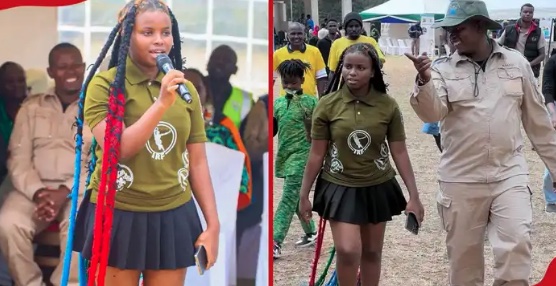
Kenyan environmental activist Truphena Muthoni found herself at the centre of a heated debate after her outfit at this year’s Mazingira Day celebrations drew sharp reactions online.
Instead of formal wear, Truphena addressed the crowd in a short black pleated tennis skirt, a green IRF-branded polo shirt, colourful long braids, and sneakers.
What Critics and Defenders Said
The event, attended by government officials and county dignitaries, became secondary to conversations about what she chose to wear.
Kenyans argued that the outfit was too casual for an official government function, with some raising the question of whether trousers would have been a more appropriate choice given the nature of the event.
Others pushed back firmly, insisting that public attention should stay on Truphena’s environmental advocacy and track record rather than her wardrobe.
The debate put her in the uncomfortable position of having to explain herself publicly, something she appeared to wrestle with in her response.
Truphena’s Take on Outfit Controversy
Speaking about the incident, Truphena was candid but measured. She said the skirt had a decent pair of shorts underneath and that her approach to life is rooted in treating everything as a sport.
“I dress the way I feel I want to dress. And my life is a sport, by the way. Yeah, my life is a sport. So that was a sport dress, skirt, whatever. And inside that skirt was a short, very decent short,” she said.
She acknowledged that her dressing choices have an impact on others but stopped short of offering an apology, saying she felt good about herself on the day.
When pressed further on whether the church-like environment of the event should have influenced her choice of clothing, she appeared to reflect briefly before concluding with a straightforward statement:
“I acknowledge that it bothers people how I dress that Saturday. I don’t know what to say about it.”
Truphena Not New to Wardrobe Controversy
This is not the first time Truphena’s wardrobe has drawn commentary. She faced similar criticism earlier this year when she travelled to Brasília, Brazil, for Acampamento Terra Livre 2026.
At the time, she argued that as an Afro-Indigenous woman and a sister to the forest, the moment meant everything to honour who she was and the roots she carries.
She has also previously explained the deliberate symbolism behind her colour choices, saying black represents African power and resilience, green stands for reforestation and hope, red signals indigenous resistance, and blue honours water and ocean defenders.
For Truphena, whose environmental message brought her to Mazingira Day in the first place, the conversation about a skirt threatened to drown out everything else she had to say.