
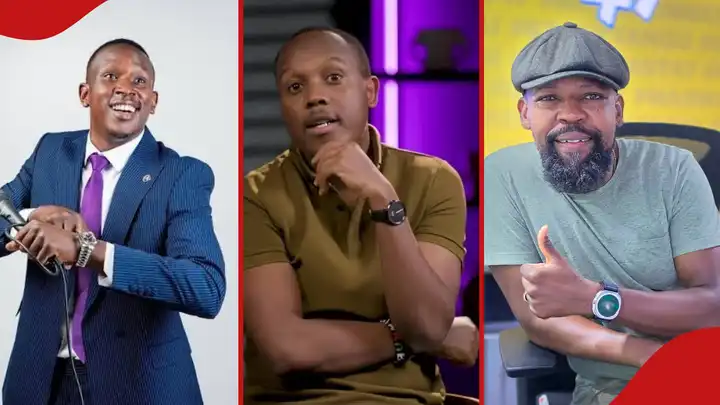
For a long time, Kenya’s entertainers operated under an unspoken rule: stay in your lane. But that rule is being rewritten, with musicians, actors, comedians, radio personalities and influencers increasingly stepping into national political conversations.
The shift gained momentum during the 2024 Gen Z-led demonstrations against the Finance Bill, when several celebrities moved beyond social media posts to physically join protests.
Musicians Bien-Aimé Baraza, Octopizzo and Bensoul publicly commented on the unrest, while Jackie Matubia, Murugi Munyi and Charisma were among those who took to the streets in Nairobi.
What is driving celebrities into political conversations?
Governance and democratic consultant Ruth Bolo told Newsunplug.co.ke that the 2024 protests fundamentally changed how celebrities relate to political discourse.
“Politics affects everyone’s life,” she said, noting that many entertainers who had previously avoided the subject were pushed in by their own fan bases. “A lot of their fan base have also been keeping them in check,” she added, pointing to audiences who questioned why their favourite personalities stayed quiet during the demonstrations.
Bolo also noted that some celebrities see political visibility as a stepping stone. Online popularity, she cautioned, does not automatically translate into votes.
“More often than not, it’s very difficult for you to translate into votes. A lot of work needs to go into it so that it actually translates into votes,” she said.
On the question of influence, Bolo was direct about the potential celebrities carry.
“Association to celebrities first of all already changes perception,” she said, adding that confirmed political endorsements can shift public opinion significantly.
She did, however, flag the risks of misinformation, noting that when celebrities spread inaccurate information, even unintentionally, “it can easily turn sour.”

Alex Mwakideu on why he broke his silence Radio personality Alex Mwakideu offered a personal account of why he began speaking publicly about national issues.
“These are issues that affect me. I’m just a Kenyan, and I live in this country. And this country is all I have,” he told Newsunplug.co.ke
Having voted in every election since 2002, Mwakideu said he reached a point where staying silent no longer felt tenable.
He stressed that his goal is not partisan cheerleading but rather focusing on what he called “the agenda,” pointing to infrastructure developments in his home county of Taita Taveta as examples of issues worth discussing on their own merit.
“Kama ni mzuri, sema. Kama ni mbaya, sema. Lakini usiseme nani unafanya,” he said, expressing a desire for more honest, outcome-focused conversations rather than political tribalism.
Bolo echoed a similar hope, saying she would like to see celebrities use their platforms for civic education and more objective political discussion, particularly in ways that move away from ethnic divisions.
Consequences celebrities face for speaking up
Public figures who take positions on contentious issues can face criticism, online backlash and accusations of advancing particular political interests.
Their statements can also be scrutinised more closely because of the influence they command.
There is also the question of credibility. While celebrity status can help draw attention to issues, popularity does not automatically translate into political expertise.
“The biggest problem we have in the country is that when you’re on the side where other people are not happy, kuna yule ambaye yuko happy, anafurahiya. Yule hayuko happy anasema umelipwa. I’ll give an example. Mercy Masika the other day ametangaza ile stori yake. Ile stori yake alipotangaza, si mi nasikia kwamba imekuwa sold out already? While other people are complaining, other people are signing up. It’s a sold-out event. So,watu wakisema umelipwa, umelipwa na nani? Unamtoa wapi mlipaji? The thing I’m saying is, let us focus on the issues, not so much where you belong,” added Mwakideu.
Expecting entertainers to remain silent simply because their careers are built around entertainment overlooks their place in society as citizens.
Ultimately, Kenya’s changing public discourse suggests that the line between entertainment and civic engagement is becoming increasingly blurred.
Whether they choose to support, criticise or question those in power, celebrities are finding that their platforms can be used for conversations that reach well beyond music, comedy, television and radio.
And as the country continues to grapple with questions of leadership, accountability and its political future, the question may no longer be whether celebrities should speak, but how responsibly they use the influence they have.
“Celebrities can really influence public opinion on a lot of the political discourse that is happening in Kenya and they’re also able to influence civic engagement. But, how I wish I would see them influence it towards a lot more civic education, objective political discussion, in a way that dilutes the ongoing tribal, or ethnic direction that our politics is currently taking,” pointed out Bolo.