

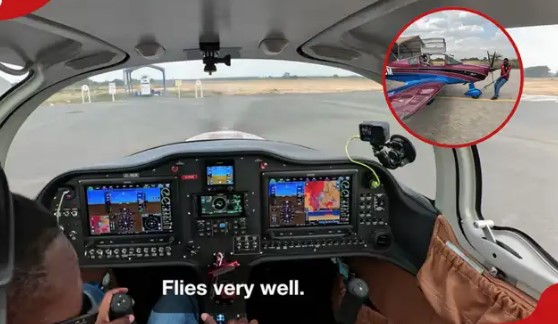
Cabinet Secretary Alfred Mutua has offered fans a closer look at his personal aircraft, revealing some of the interesting features that make it suitable for long-distance journeys and landings in remote locations.
The former Machakos governor frequently takes to the skies, piloting his four-seater Sling TSi aircraft, registered as 5Y-MCM, to different destinations in Kenya and neighbouring countries.
In a recent tour of the aircraft, Mutua explained its capabilities, including its fuel requirements, flying endurance, cockpit technology and ability to land on different types of surfaces.
One of the most interesting revelations was that the South African-made aircraft can use Mogas, a type of automotive petrol also used by ordinary vehicles, as well as Avgas, which is specially formulated for aviation.
This gives the aircraft flexibility in its fuel options, although the appropriate fuel must meet the engine manufacturer’s specifications.
1. Aircraft made in South Africa
The Sling TSi is manufactured by Sling Aircraft, a South African aviation company known for producing light aircraft.
It is a four-seater, single-engine aircraft designed for private flying, cross-country journeys and recreational aviation.
Its low-wing design, spacious cabin and modern construction make it an interesting option for pilots looking for a relatively compact aircraft with impressive touring capabilities.
Mutua’s aircraft carries the Kenyan registration 5Y-MCM.
2. Uses petrol found in cars
One of the details Mutua highlighted during the tour was the aircraft’s ability to operate using Mogas or Avgas.
Mogas is automotive gasoline, meaning it is the type of fuel commonly used by petrol-powered cars, provided it meets the engine’s approved specifications.
Avgas, on the other hand, is aviation gasoline specifically produced for aircraft engines.
The distinction is important because not every type of automotive petrol is approved for every aircraft engine.
3. Can fly for 8 hours on full tank
Mutua also explained that the aircraft can remain airborne for approximately eight hours when its tank is full.
This endurance makes it particularly useful for longer journeys, allowing the pilot to cover considerable distances without having to make frequent fuel stops.
The actual flying time depends on factors such as cruising speed, fuel consumption, weather, payload and operating conditions.
The aircraft has a fuel capacity of approximately 198 litres, although the usable quantity and achievable endurance depend on its configuration and operating limits.
4. Features glass cockpit and autopilot
Inside the aircraft, the cockpit is fitted with modern digital technology. The Sling TSi features a glass cockpit, which uses electronic displays to present important flight information instead of relying entirely on traditional analogue instruments.
Depending on the configuration, its Garmin avionics provide navigation, flight monitoring and engine information.
The aircraft also has an autopilot system, which assists the pilot in maintaining selected flight parameters during a journey. These features are particularly useful during longer cross-country flights.
5. Four-blade propeller and impressive climbing ability
Another feature Mutua highlighted was the aircraft’s four-blade propeller. He also explained that the plane climbs at approximately 1,200 feet per minute, demonstrating its ability to gain altitude relatively quickly under suitable operating conditions.
Its turbocharged Rotax engine provides the power needed for its performance, while the propeller converts that engine power into thrust. Mutua also described the aircraft as easy to handle, making it an appealing machine for private flying.
6. Has a parachute for emergencies
The Sling TSi can also be fitted with a whole-aircraft ballistic parachute recovery system.
Unlike an ordinary parachute used by an individual, this system is designed to deploy a parachute capable of bringing the entire aircraft down during certain emergencies.
It provides an additional potential safety measure when a pilot encounters circumstances in which continuing controlled flight may not be possible.
However, its effectiveness depends on the circumstances of deployment, and it is not a substitute for proper flying procedures.
7. Can land on tarmac and in the bush
Perhaps one of the aircraft’s most interesting capabilities is its versatility when it comes to landing locations.
Mutua explained that the Sling TSi can land on conventional paved runways as well as suitable bush airstrips.
This capability has allowed him to visit destinations that may not be conveniently served by scheduled commercial flights.