


Climate change continues to cripple agriculture and slow economic growth, but at Butere Technical Training Institute (TTI), trainers and students are looking for answers right in the garden.
Their latest innovation, a natural supplement that does not harm the soil, is already turning heads. According to the trainers, farmers are buying into the idea, and it is yielding results.
At the centre of it all is the principal, Pamela Mwale, who started the project hoping it would one day help farmers do away with inorganic fertilisers that threaten the health of the soil.
While students get their knowledge and skills from their trainers, they are the ones who put them into practice, with the trainers supervising.
Mwale keeps red German wiggler worms and feeds them every day on kitchen leftovers from the students and refuse collected after garden harvests, mostly kales and cabbages.
The worms pass the waste through their digestive system and produce cast and vermijuice, the liquid she refers to as worm urine. She harvests at least 0.5 litres, with a litre going for KSh 1,500, meaning she makes a minimum of KSh 750 daily. When the worms are well fed, the harvest can go up to five litres.
“When they are well fed, they produce five litres per day, and one litre costs 1,500,” she said.
At that peak, she can earn up to Kshs 7,500 a day. But it was not always so sweet. Mwale started the project a year ago and says the early days were full of struggles, with very little to show for the effort, but today, things have changed for the better.
“I only feed them cabbage and kitchen remains from the students. They are highly nutritious and help the worms multiply and produce more juice,” she added.
The vermijuice is used as both a fertiliser and a pesticide on natural garden plants, including vegetables.
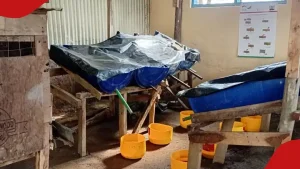
The project has paid off in several ways; first, it has cut spending on synthetic fertiliser, where the institution now produces enough for its school farm, with extra vermijuice left over for sale.
That sale has become an important income-generating activity for the institute.
Second, the soil itself has changed. Earlier tests found the school’s soils to be very acidic, but Mwale says that thanks to the vermicompost juice and cast, the soil pH is now neutral.
The worms have also solved a stubborn waste problem. Disposing of kitchen residues from the school was once a crisis because of the foul smell. Now the red wigglers eat the waste, and the smell is no longer an issue.
According to her, the Kenya Agricultural and Livestock Research Organisation (KALRO) in Kakamega tested the school’s soils. According to the institution, the results showed plenty of useful micro-organisms, good aeration, good soil structure and good water-holding capacity. Mwale says this has translated into double yields.
The vermicomposting area has also become a classroom. Many trainees come from the surrounding community and use the site as a learning area. A good number have been trained, and the institution followed up with them and helped them set up their own projects.
Rabbits at the institution join the team as the worms are not the only animals pulling their weight. Mwale also runs a rabbit project at the institution, again for their urine, which she says works as both a fertiliser and an insecticide.
“I also rear rabbits for their urine, which farmers use as fertiliser and insecticide,” she said.
Mwale believes the days of relying on factory-made fertilisers should end. In her view, farmers who want their soils to keep their nutrients must turn to homemade organic fertilisers made from animals and plants, which she describes as harmless.
She cautioned that years of continuous chemical fertiliser use have sharply reduced soil nutrients and killed the bacteria that help multiply nutrients in the soil.