

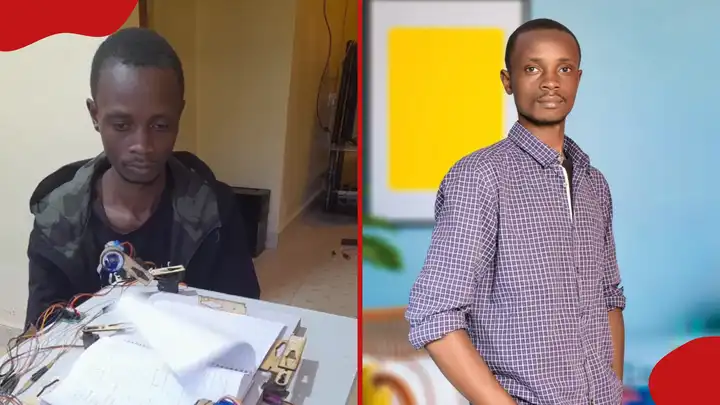
An innovator from Eldoret is drawing admiration across Kenya after building a device that could transform how people living with disabilities access books and reading materials independently.
Cliff Temba has developed a bidirectional automatic book page turner, a custom-built machine designed to allow users to flip through the pages of a physical book without needing any hand movement or outside help.
The device, which incorporates visible wiring, servos and a notebook for demonstration, was filmed operating at what appears to be a home workshop or personal workspace.
What does Temba’s innovation address?
For many people living with physical disabilities, something as routine as reading a book can present a significant challenge.
Temba’s invention addresses that gap directly by automating the page-turning process in both directions, meaning a reader can move forwards and backwards through a book at will.
The demonstration footage, shared on Facebook, shows Temba seated at a desk and operating the device himself, with on-screen text identifying both the innovator and his creation.
Temba’s work sits within broader tradition of Kenyan makers
The tone of the video is quietly confident, presenting the invention not as a prototype in a formal research lab but as something built from determination and practical thinking.
The video has begun circulating widely online, with many viewers responding to the story as an example of the kind of grassroots innovation that rarely receives institutional backing but solves real problems in real communities.
Temba’s work sits within a broader tradition of Kenyan makers and tinkerers who build solutions outside of formal engineering pipelines.
Should a locally designed and built page turner be developed further?
Assistive technology remains an underfunded area across much of sub-Saharan Africa, where people with disabilities often face limited access to tools that could support their independence.
A locally designed and built page turner, should it be developed further and made accessible, could serve students, readers and learners who currently rely entirely on a caregiver to help them navigate a physical book.
No details about the cost of the device or Temba’s plans for wider production have been shared publicly at this stage.