

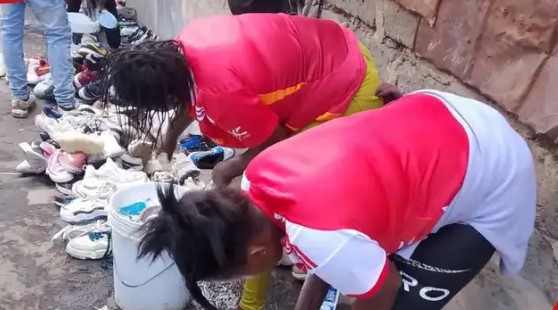
A Gikomba Market trader has raised concern over the forced exit of Burundian workers who had been earning a living washing shoes at the popular Nairobi market, saying their departure will be felt by the businesses that relied on them.
Chrispine Amollo, who identified herself as one of the traders who employed Burundian hustlers at Gikomba, posted on Facebook on September 6, lamenting the situation.
She wrote that the women who washed shoes for traders at the market would “never do it again” from the following day, following President William Ruto’s directive targeting foreigners in informal trade.
Why Gikomba Trader Prefers Hiring Burundians
The post came shortly after President Ruto publicly warned foreign nationals against occupying small business opportunities that he said should be reserved for Kenyans.
The directive prompted a visible reaction among the Burundian community in Nairobi, with many rushing to their country’s embassy to obtain travel documents ahead of a feared crackdown.
Amollo, while acknowledging the president’s move, used his post to push back against the narrative that Kenyans were ready to fill those roles. She argued that Kenyan youth were unwilling to take up jobs offering modest wages, citing a case where a jobless person he knew turned down a KSh 13,000-a-month position as insufficient, while a Burundian worker was content earning KSh 8,000.
“Someone tells you they are jobless, and when you tell them there is a job at KSh 13,000 salary, they say that money is too little, but a Burundian is okay with even KSh 8,000. Is it not better to employ someone you can afford?” Amollo wrote.
She closed his post by appealing to the president to let the foreign workers remain.
Kenyans Divided on the Crackdown
The post drew sharp and varied responses online.
@Fostine said: “There is a procedure for coming in. Let them go and start the work visa applications then come back. We don’t want people who sneak in, for security purposes too.”
@Kamami raised the issue of reciprocity, writing: “I am sure there are Kenyans doing business in Burundi, Congo, and other countries of East and Central Africa. What if they are sent away?”
@Amodyna offered a personal counterpoint to Amollo’s portrayal of Kenyan youth, writing: “I am a Gen Z and my first hustle was hawking flasks in CBD. I have even been caught by City Hall trying to make a sale. I hawked soap too and did construction work before getting my first job. Now I am in my second job, so I don’t know which Gen Z you are talking about.”
The debate reflects broader tensions in Kenya over informal labour, youth employment, and the role of East African migrants in the country’s street economy.