
The elite sport’s grand return to Africa marks the end of an agonizing multi-decade absence.
Since 1993, Africa has been the missing piece on Formula 1’s global calendar, making F1 a true world championship in name only.
But Formula 1 is not a newcomer to the continent. Africa boasts a rich, colorful, and storied history in top-tier motorsport that dates back to the dawn of the World Championship era in the 1950s and 1960s.
The first official Formula 1 World Championship race on African soil took place on the blistering Ain-Diab Circuit in Casablanca, Morocco, in 1958.
Won by Stirling Moss in a Vanwall, the race remains legendary – not only for crowning Vanwall as the inaugural Constructors’ Champion, but also for the tragic accident involving British driver Stuart Lewis-Evans.
After crashing heavily at the dusty Ain-Diab Circuit during the season-ending Moroccan Grand Prix, Lewis-Evans car’s engine seized and sent him lurching into barriers at high speed, where it burst into flames.
He was airlifted back to the UK, but died of his burns in hospital six days after the accident.
South Africa soon took over the mantle, hosting its first official World Championship Grands Prix at the coastal town of East London on the Prince George Circuit between 1962 and 1965. Racing icons like Graham Hill and Jim Clark claimed victory on this tight, seaside track.
In 1967, the South African Grand Prix moved to the high-altitude Kyalami Circuit near Johannesburg.
Kyalami became an instant fan and driver favorite due to its flowing layout, blistering speeds, and challenging elevation shifts.
Kyalami produced iconic moments, including local hero Jody Scheckter’s home victory in 1975 before he went on to win the 1979 World Championship with Ferrari, as well as Niki Lauda’s famous comeback wins.
Sitting over 1,500 meters above sea level, Kyalami forced teams to engineer unique engine setups to compensate for thin air, giving birth to massive turbocharger experiments in the late 1970s and 1980s.
Formula 1’s departure from Africa in the late 20th century occurred in two distinct phases, driven by geopolitics and financial realities.
The first departure came in 1985 as global opposition to South Africa’s Apartheid regime reached a boiling point.
International sporting boycotts grew fierce, and pressure mounted directly on racing teams.
First, the French government forced teams like Renault and Ligier to boycott the 1985 South African Grand Prix.
Following that race, the FIA formally removed Kyalami from the race calendar for 1986.
The second departure occurred after a brief return.
Following the collapse of Apartheid and the release of Nelson Mandela, Formula 1 returned to a modernized Kyalami in 1992 and 1993. However, this revival was short-lived.
The promoter entity collapsed under massive financial deficits and mounting debts.
With the FIA requiring costly facility upgrades that Kyalami could not afford without substantial state backing, the circuit fell off the schedule after 1993, leaving Africa without a Grand Prix for over three decades.
While many motorsport analysts expected South Africa or Morocco to spearhead Africa’s F1 renaissance, the Republic of Rwanda not surprisingly secured the winning bid.
On October 13 2026, Formula 1 officially confirmed a 10-year deal for the Formula 1 African Grand Prix.
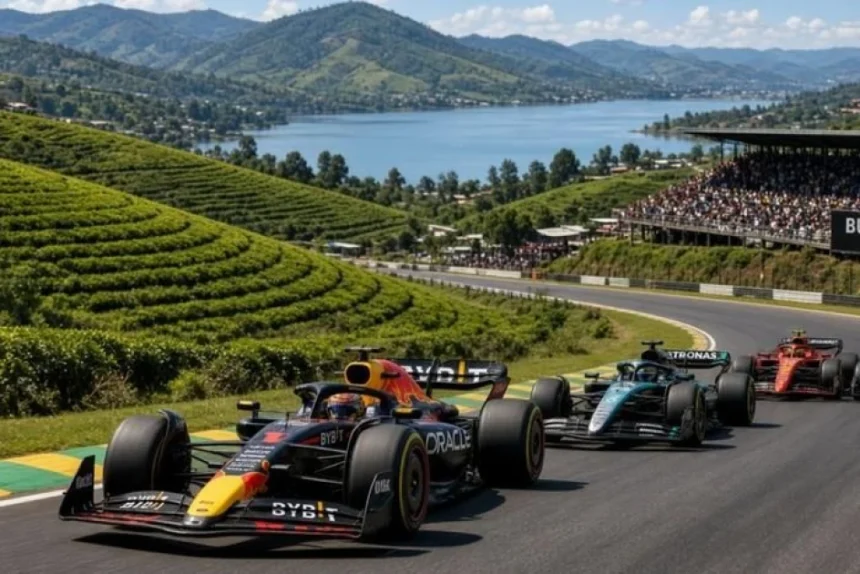
Set to join the racing calendar in the early 2030s, the event will be hosted at a brand-new, purpose-built motor racing facility in Bugesera, located roughly 40 kilometers south of Rwanda’s capital, Kigali.
Designed by former F1 driver Alex Wurz and his team, WurzDesign, the track is being constructed to strict FIA Grade 1 standards.
The layout features an expansive four-mile (approximately 6.4 km) circuit with 17 turns that work in harmony with the natural landscape and elevation changes.
Crucially, the circuit is situated alongside Rwanda’s new international airport in Bugesera, providing direct logistical access for team freight, cargo planes, and international spectator flow.
Rather than just an accident or an overnight achievement, Rwanda’s successful bid was the result of a meticulously executed, multi-year sports diplomacy masterclass led directly by President Paul Kagame and the Rwanda Development Board (RDB).
Tirelessly and with much passion, President Kagame personally engaged directly with F1 CEO Stefano Domenicali, FIA President Mohammed Ben Sulayem, and various team executives.
High-level Rwandan delegations also conducted site visits and built paddock relationships at major Grands Prix, including the Baku and Lusail events.
A pivotal milestone came in December 2024, when Kigali hosted the prestigious FIA General Assembly and Prize Giving Ceremony.
By hosting motorsport’s top decision-makers, Rwanda demonstrated its world-class hospitality, organizational competence, and security on a global stage.
This effort built upon Rwanda’s established “Visit Rwanda” sports diplomacy framework, which had already established high-profile marketing partnerships with major global sporting brands like Arsenal FC, Paris Saint-Germain, and the Basketball Africa League.
Formula 1’s commercial rights holder, Liberty Media, sought a host country that offered complete government alignment, long-term financial backing, modern infrastructure, and political stability – a package Rwanda sought to present with absolute clarity and solid compliance.
“Africa has always been part of Formula 1’s future, and from the beginning we were determined to return in the right way, with the right partner, a long-term commitment and a clear vision for creating meaningful impact,” F1 president Stefano Domenicali said.
Driver advocacy also played a significant role. Seven-time World Champion Lewis Hamilton repeatedly used his public platform to urge F1 leadership to bring the sport back to Africa, creating strong moral and commercial momentum across the paddock.
In 2021, he specifically mentioned South Africa as a possible race site. Ahead of that year’s United States Grand Prix in Austin, he said the country is “dear to my heart.”
“I think there’s a great following out there,” he said then. “I think it would be great to be able to highlight just how beautiful the motherland is.”
Ultimately, Rwanda prevailed over several prominent competitors across Northern, Western, and Southern Africa.
South Africa sought a return to the Kyalami Grand Prix Circuit, leveraging its deep F1 heritage and existing Grade 2 facility. However, complex disputes between private promoters and public funding bodies, political frictions, and promotional cost bottlenecks repeatedly stalled a final agreement.
Morocco also proposed venues in Tangier and Marrakech, highlighting its proximity to Europe and its track record of hosting Formula E and World Touring Car races.
On its part, Morocco focused a significant portion of its capital guarantees on stadium and transport infrastructure for co-hosting the 2030 FIFA World Cup.
Egypt too explored a Grand Prix proposal centered near its New Administrative Capital and Giza, putting forward a luxury sports-tourism pitch.
However, the project remained in its early conceptual stages compared to Rwanda’s advanced planning.
Zanzibar in Tanzania also pitched an island resort circuit designed for high-end sports tourism, but faced significant feasibility and infrastructure hurdles in meeting strict FIA Grade 1 standards.
The return of Formula 1 to African soil carries immense symbolic, cultural, and geopolitical weight.
First, it restores true global representation to the sport. Africa is home to over 1.4 billion people and has the youngest population on Earth.
Therefore, hosting a Grand Prix validates Africa’s place in the modern global sporting ecosystem and ensures F1 ultimately lives up to its World Championship title.
Second, it accelerates a positive shift in global perception. For decades, international media narratives around Africa focused primarily on aid and developmental challenges.
Now, hosting the most technologically advanced, expensive, and logistically demanding annual sport on Earth projects a powerful image of modern capability, innovation, and infrastructure readiness for a continent usually unfairly viewed as backward, underdeveloped and stunted in economic growth.
Third, it inspires the next generation. A local Grand Prix offers young African students, engineers, mechanics, data scientists, and aspiring drivers a visible, direct pathway into the glorious magic, endless possibilities, power and opportunities such a fabulous sport brings with it.
As President Paul Kagame stated during the announcement, this moment belongs to Africa.
“We want to contribute, not just participate, and this new chapter in motorsports starts today and integrating African markets with global sports franchises and competitions offers transformative opportunities. Sports is a great equaliser, but we have to be intentional about delivering this promise,” Kagame said in a statement.
The 10-year agreement to bring Formula 1 to Rwanda is far more than a sporting contract – it is a landmark development project for the African continent.
From the straits of Casablanca in 1958 and the iconic hills of Kyalami to the modern circuit taking shape in Bugesera, Formula 1’s journey in Africa has come full circle.