

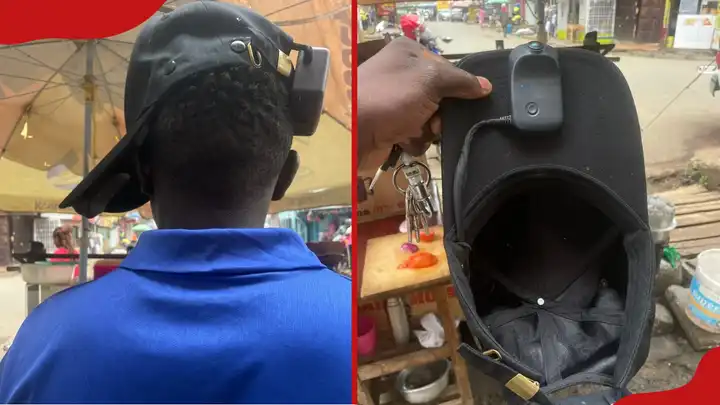
Mysterious camera caps have been spotted on the heads of ordinary Kenyans going about their daily activities in different parts of Nairobi, sparking curiosity and questions about what exactly they are recording.
From Kasarani to Umoja and Utawala, people wearing unusual caps fitted with tiny cameras have attracted attention, with some residents wondering why individuals would walk around recording their everyday encounters.
Why Kenyans wear camera caps
Details indicate that the devices are wearable first-person camera rigs fitted with two small lenses positioned side by side.
Unlike ordinary cameras, which capture footage from a fixed position, the gadgets record what the wearer sees as they go about their business.
The footage reportedly captures ordinary activities such as handling tools, sorting items, preparing food, picking up objects and packing goods.
According to K24 Digital, the recordings are linked to the development of artificial intelligence and robotics systems.
AI research in progress
The technology falls under a growing field known as embodied AI, which focuses on developing machines capable of interacting with the physical world.
Robots need to learn how humans perform everyday activities, including handling objects, using tools and moving items from one place to another.
By studying footage recorded from a person’s perspective, developers can gather examples of how humans interact with their surroundings and use the information to train machines to perform similar tasks.
The report suggests that the devices are being used to collect real-world footage rather than relying entirely on staged demonstrations.
How much are Kenyans being paid?
The unusual arrangement has also attracted attention because participants are reportedly receiving money for wearing the devices while carrying out their normal activities.
A spot check showed that some individuals wearing the cameras claimed they were being paid approximately KSh 50 per hour.
Other social media reports have put the payments at around KSh 90 per day, although the different figures have not been independently reconciled.
Casual workers, mechanics, laundry workers commonly known as mama fua, and other residents have reportedly been spotted wearing the gadgets.
However, the organisations commissioning the recordings and the exact arrangements governing the work have not been publicly established.
Privacy concerns emerge over camera caps
While the technology could contribute to the development of more advanced AI and robotics systems, the practice has raised questions about privacy and consent.
Because the cameras record what the wearer sees, they could capture shoppers, customers, business owners and unsuspecting members of the public going about their activities.
This has prompted questions about whether people appearing in the footage know they are being recorded and whether they have consented to it.
There are also concerns about who owns the recordings, where the footage is stored, who has access to it and how long it is retained.
Another question is whether the devices capture audio alongside video and what safeguards exist to prevent the information from being misused.
For now, the camera caps have introduced an unusual sight in parts of Nairobi, turning ordinary daily activities into potential training material for the next generation of artificial intelligence and robotics.