

New York and 21 other states have filed a lawsuit against the Trump administration to block a new Department of Homeland Security (DHS) rule that gives immigration officials broader discretion to deny green cards, visas, or entry into the United States based on whether applicants could become dependent on government aid.
The pending rule change expands the categories of government benefits that immigration officials can evaluate when determining whether an applicant constitutes a “public charge.”
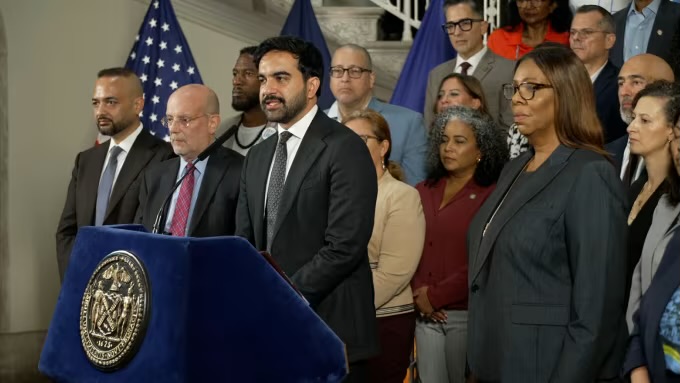
New York State Attorney General Letitia James and New York City Mayor Zohran Mamdani, leading a coalition of cities filing a parallel action, announced the legal challenge during a news conference at Manhattan City Hall. NewsAggregation Platform
“The rule would allow immigration officers to consider use of critical benefits like Medicaid and SNAP (the Supplemental Nutrition Assistance Program), and even participation in school meal programs, as part of an applicant’s circumstance,” James stated.
“That means immigrant New Yorkers may be forced to ask themselves impossible questions: ‘Will getting health insurance hurt my chances of getting a green card? Will accepting food assistance when I fall on hard times be held against me?’”
The legal challenge centers on revisions to the “public charge” rule, an established provision of federal immigration law authorizing the government to deny visa or green card applications to individuals deemed likely to rely on government assistance.
Historically, immigration evaluations accounted strictly for cash benefits, including Supplemental Security Income and Temporary Assistance for Needy Families. Under the updated DHS framework, officials are not restricted to cash assistance, permitting non-cash benefits, such as housing vouchers and Medicaid, to be factored into eligibility determinations.
The rule targets individuals maintaining legal status in the United States, as undocumented immigrants remain ineligible for federal public benefits.
The policy shift follows federal legislative measures, including the “One Big Beautiful Bill Act” enacted in July 2025, which restricted legal immigrant access to Medicaid and food assistance while excluding refugees, asylees, and victims of domestic abuse or sex trafficking from eligibility. While U.S. citizen children retain eligibility, state officials note that administrative updates frequently induce widespread disenrollment among eligible mixed-status households due to immigration enforcement concerns.
The lawsuit filed by New York contends that DHS exceeded its statutory authority, arguing Congress never authorized a expanded definition of the public charge provision. The legal filing further asserts the rule is “arbitrary and capricious,” alleging DHS failed to justify the expansion or evaluate the economic damage to state healthcare and social welfare systems.
Both the state coalition lawsuit and the local government suit, joined by Chicago, San Francisco, Seattle, Santa Clara County, and King County were filed in the U.S. District Court for the Southern District of New York. The petitions ask the court to declare the policy unlawful and enjoin DHS from implementing the rule.
“Cruelty is the point (of the rule change),” James said. “Having a chilling effect on immigrants is the point. Letting individuals know that they are not welcome here is the point. Immigration animus is the point.”
“The fact that you’re going to deny individuals who are sick and hungry and homeless benefits just is beyond the pale. And that’s why we are seeking in the state of New York to vacate this rule,” she added.
Mayor Mamdani noted that federal policy shifts have already produced noticeable declines in public benefit enrollments among vulnerable urban populations.
“We’re talking about something that we know categorically does not apply to certain sets of New Yorkers, and yet we’re already seeing evidence of those kinds of New Yorkers unenrolling from life-saving benefits,” Mamdani said.
“To see the federal government pursue rule changes and legislation that will make hungry New Yorkers hungrier, that will make poor New Yorkers poorer, it is a slap in the face to everything that we should be doing in this moment, which is to make it easier for working-class New Yorkers to afford their life here in the city.”