

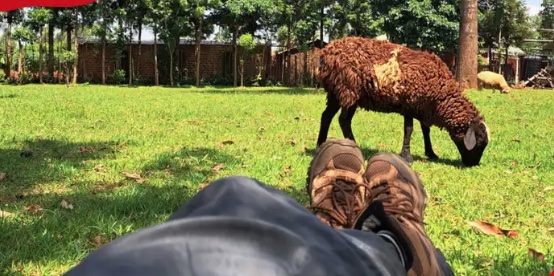
A Kenyan man who invested in sheep farming in Mweiga, Nyeri County, has narrated how the project collapsed around him, leaving him with just three animals and a hard set of lessons about passive income.
The investor, who holds a demanding full-time job, partnered with a friend who had inherited idle land in Mweiga.
He told Money254 that together, they put in a combined minimum of KSh 400,000, with each contributing approximately KSh 200,000.
How Nyeri Sheep Farming Venture Began
The idea took root after the investor noticed how sharply the price of goat meat had climbed, paying KSh 900 for a cut that had once cost far less.
He spent roughly two years researching livestock farming before the conversation with his land-owning friend gave him a concrete opportunity to act.
Their original plan was modest: purchase 20 young sheep, fatten them and sell them during the Christmas period when meat demand surges.
They eventually settled on Dorper sheep rather than the local Kikuyu breed, drawn by research suggesting Dorpers gain weight more quickly.
The breed cost approximately KSh 10,000 per animal, steeper than local alternatives, but the partners believed faster growth would justify the premium
To manage the flock while they remained in Nairobi, they hired a distant relative of the investor and offered him a salary, hoping a personal connection would guarantee reliability.
Theft and Deaths Drain the Investment
The arrangement frayed quickly. The shepherd communicated poorly, and reports of illness only reached the partners when animals were already in critical condition.
Ewes that fell sick after giving birth died, and their lambs followed shortly afterwards. Each death hit twice: a mature animal was lost alongside the offspring that would have helped grow the flock.
When a request for funds to cover injections arrived without any prior warning that the animals were unwell, the partners threatened to deduct pay for future deaths caused by negligence.
Looking back, the investor acknowledged that threat was a patch, not a solution.
Night He Lost Sheep
Then came the night that changed everything. After the shepherd requested a salary advance, citing a medical emergency involving his wife, the partners sent the money.
That same night, 15 sheep were stolen from the pen situated just outside the shepherd’s bedroom.
Police noted there were no clear signs of forced entry and learnt the shepherd had apparently not slept at the farm that night.
He resigned at around 7 pm the following day. The investor suspected the thieves had used the farm’s weight records to select targets, because the animals taken were the heaviest in the flock.
Lessons Learnt
Four more sheep died in the weeks that followed, shrinking what remained to six animals. The investor ultimately exited the business with just three sheep, valued at roughly KSh 30,000.
He now argues that the farm lacked the basic infrastructure any livestock business requires from day one: security cameras, independent veterinary oversight, written illness-reporting procedures and reliable weight records.
“I have simply learnt that passive income is rarely passive at the beginning,” he said, adding that whoever delegates operational responsibilities must still build in accountability mechanisms.
He has not abandoned the idea of sheep farming entirely, but he no longer views it as a straightforward or low-effort business.