

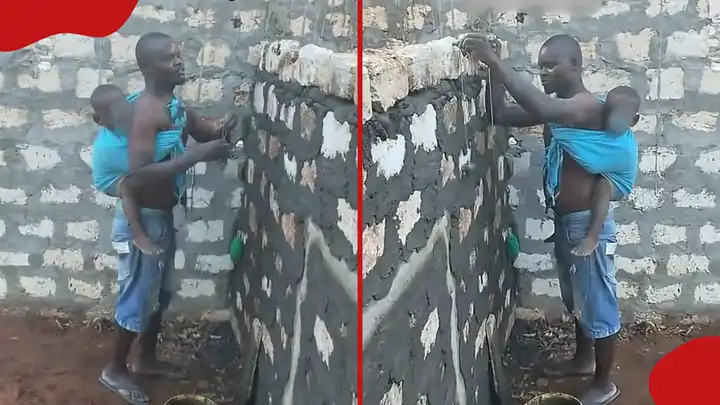
A Kenyan man has captured the attention and admiration of thousands online after a video emerged showing him laying bricks at a construction site, commonly known as mjengo, with his young baby tied securely to his back.
In the clip, the bare-chested man works steadily on a wall, his infant son strapped snugly against him using a blue leso in a style typically associated with mothers.
Dressed in denim shorts and slippers, he moves about the site without breaking pace, while the baby gazes around quietly, seemingly unbothered by the noise and activity around him.
A Father Carrying More Than Bricks
What made the footage resonate so widely is how unusual the sight is. Men carrying babies on their backs, let alone at a physically demanding worksite, are rarely seen in Kenya.
The image of this father refusing to let childcare interrupt his daily hustle struck a nerve with viewers across the country.
The video spread rapidly, drawing a wide range of responses. Some found it deeply moving, others saw humour in it, and a number used it to open up conversations about single parenthood and gender roles.
Quincy wrote:
“Sharp boy is so quiet there and feeling the warmth from dad’s back.”
Hehe commented:
“At least the kid got your back, bro. Man, did he die?”
Rn.Rue🇰🇪🇨🇦 quipped:
“The first person to fulfil the ‘nizalie nitalea’ promise.”
Susan Nayamai had a more pointed observation:
“What’s new here? Ladies go through this every day. Nothing makes me happier than when I see a single father. Girls, let’s make this happen.”
Mimily wrote:
“Unaona uzuri wa kumwachia mtoto wake. Such a loving father. Lep nimeona single mother.”
Lastmanstanding shared a personal note:
“Ata Mimi niliachiwa ili niteseke lakini Mungu wangu sio mawe. Eti ni Leo Mimi Niko na domestic managers wawili wa shamba na wa nyumba and when she was around it was just a dream.”
The range of reactions reflects how deeply the video connected with Kenyans navigating their own experiences of parenthood, partnership and responsibility.For many, the man at the mjengo site represented something bigger than a single moment caught on camera.