

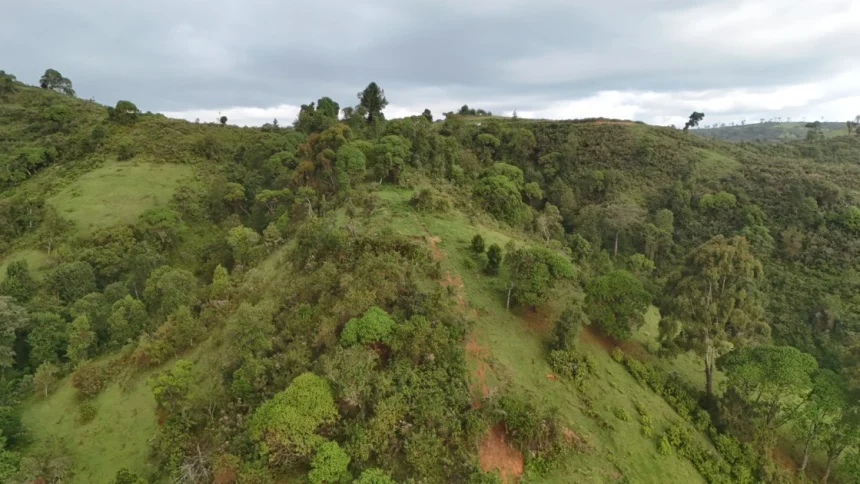
Interior Cabinet Secretary Kipchumba Murkomen has unveiled a Ksh.14.7 billion environmental restoration initiative aimed at reversing ecological degradation in the Cherangany Hills ecosystem following the deadly Chesongoch landslides that left at least 26 people dead and dozens others missing in Elgeyo-Marakwet County.
The October 31, 2025 disaster struck Chesongoch after hours of heavy rainfall triggered fast-moving landslides that swept through homes, farms and valley settlements. Survivors describe a sudden and eerie shift in conditions shortly before the catastrophe unfolded.
Mathias Jelimo, one of the survivors, recalled how the night turned from ordinary rainfall into a life-threatening emergency within moments.
“By around 9 p.m., the valley changed. The land went completely silent… we asked, what is wrong?” he said.
Moments later, a thunderous roar broke the silence as mud and floodwaters surged downhill, forcing families to flee in darkness. With roads cut off and access to medical facilities severed, residents mounted desperate rescue efforts, pulling neighbours from the debris and converting nearby schools into makeshift emergency shelters.
By morning, the full scale of destruction had become evident—homes flattened, farms washed away, and entire sections of the valley radically reshaped.
In the aftermath, residents say the disaster exposed deeper environmental vulnerabilities. Jelimo and other survivors point to years of deforestation, cultivation along riverbanks, and encroachment into forested areas as key factors that destabilised the landscape and intensified the impact of the landslides.
“When we assessed everything, we saw the forest is disappearing; this is what has brought this disaster,” Jelimo said, warning that loss of tree cover had left slopes exposed and highly susceptible to erosion.
In response, the government has launched the Cherangany Hills Ecosystem Restoration for Livelihood Improvement, Sustainability and Harmony (CHERISH) programme, a 10-year initiative targeting the rehabilitation of more than 62,000 hectares of degraded land across the ecosystem.
Murkomen, who is the programme’s patron, said the increasing frequency of landslides and other climate-related disasters underscores the urgent need to treat environmental degradation not only as an ecological concern, but also as a matter of national security and human safety.
The initiative will focus on restoring forest cover, protecting water towers, rehabilitating riparian zones, and promoting sustainable livelihoods through agroforestry, eco-tourism and beekeeping. It also aligns with the government’s broader target of planting 15 billion trees by 2032.
Murkomen is expected to formally launch the CHERISH programme in Kapyego, Marakwet East, on May 21, 2026, in a large-scale indigenous tree-planting exercise involving the Sengwer indigenous community, which has endorsed the conservation-led approach.
Speaking during a recent partners’ roundtable meeting, the Interior Cabinet Secretary warned that continued environmental destruction was undermining water security, livelihoods and social stability across the Kerio Valley and the wider Cherangany region.
For survivors in Chesongoch, the initiative offers cautious hope that long-term restoration efforts could help prevent a repeat of such tragedies.
Jelimo said the disaster has fundamentally reshaped community attitudes toward conservation, linking environmental protection directly to survival.
“We cannot go back to how things were. We must protect what is left and restore what we have lost,” he said.
In Chesongoch, where devastation still lingers, the disaster has become a stark reminder of the fragile balance between people and the environment—and the urgent need to restore it.