

The ban was part of a wider authoritarian turn led by John Magufuli, who became president in 2015.
Samia Hassan succeeded Magufuli upon his death in office in 2021. She signalled a new era of democratic reform, but the most substantive change she has delivered was lifting the ban on political rallies in 2023.
Her government has now reimposed the ban, this time in the wake of a violent post-election crackdown in 2025.
The government has suspended mass rallies “until further notice” because it fears that they could trigger protests that spiral out of control.
Activists had named 7 July 2026 as the date for nationwide protests against political repression.
It has become clear that Hassan’s claim to a reform agenda was something that she wanted to signal, but not deliver. Legislative reforms proved to be hollow. More substantive reforms were kicked down the road.
Instead, everyday repression has increased. Activists have been arrested, attacked or abducted. The main opposition presidential candidate, Tundu Lissu, was arrested and charged with treason in April 2025. Fifteen months later, his trial has yet to be concluded.
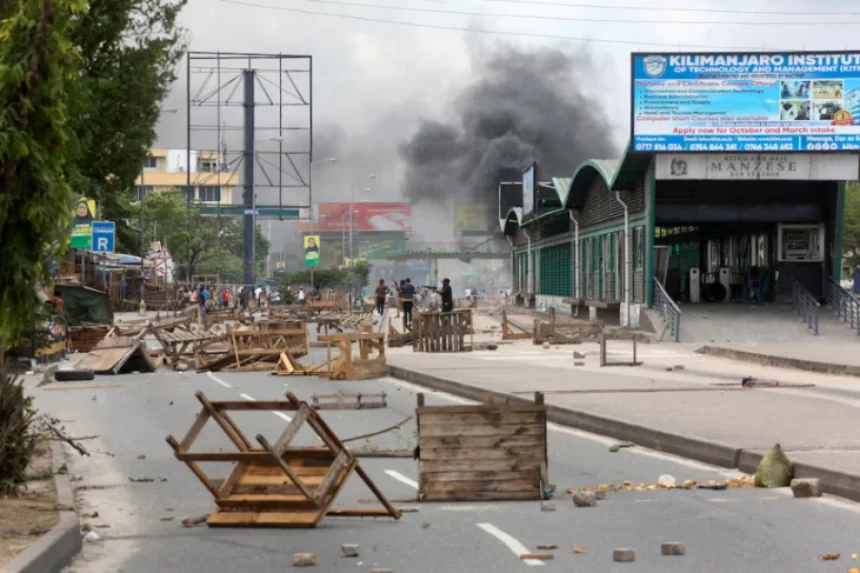
In this context, mass protests unfolded on election day in October 2025. They were met by an unprecedentedly violent crackdown.
A government-sponsored commission of inquiry acknowledged that at least 518 people were killed, but it alleged this was largely done by professional foreign agitators. In reality, the death toll may have been far higher, and the violence was in all likelihood carried out almost entirely by state security forces.
Why are political rallies so important in Tanzania?
In Tanzania, rallies are not just for election campaigns. They are also the means by which political parties mobilise and organise between elections.
This is especially true for Tanzania’s leading opposition party, Chadema.
Chadema has built a nationwide support base. By 2015, it had achieved a grassroots campaign network that matched the long-dominant ruling party, Chama Cha Mapinduzi (in power since independence in 1961).
Chadema built its party apparatus using rallies. Its leaders spent months and years touring Tanzania town by town. They addressed citizens in public squares. They communicated their people power ideology and asked for volunteers on the spot. These volunteers were made the new members of local party branches.
Aspiring Chadema leaders used the same methods to organise at the local level. Lissu was one of those aspiring Chadema lieutenants. Together, they created a national movement. The rally was the vehicle for that movement-building.
Magufuli banned rallies in this context. He was attempting to put the brakes on opposition organising.
What’s different about this ban compared with the one a decade earlier?
Chadema has been trying to organise and rebuild just as it did after rallies were unbanned in 2023. But another context looms larger in this latest rally ban: the prospect of protest.
In years past, this would not have caused the government concern.
While Tanzania had a culture of mass rallies, it had no culture of mass protest. There have been protests, but they were localised or non-partisan or small, or all three at once. See, for instance, the Maasai protests against forced relocation and protests in Mtwara against a natural gas pipeline.
Careful government repression and deterrence have kept a lid on the scale and intensity of these protests. The absence of intense protests became self-sustaining – as no one had ever witnessed protests on a major scale, few ever joined them.
That all changed in the October 2025 election when anger at political repression and long-stalled living standards radicalised public opinion and fuelled mass protests.
Suddenly, the notion that protests could not happen in Tanzania evaporated. Tanzania’s democracy movement took on a new, popular form. A people power movement was born anew.
In this context, the potential role of the rally in Tanzania changes. Any rally can simultaneously be, or become, a protest.
This has changed the picture for Tanzania’s increasingly authoritarian regime.
It only managed to suppress protests in 2025 by resorting to bloody and brutal repression. It does not want to have to do so again – it learned how quickly protests can scale and become a threat to the regime itself.
What does this mean for Tanzania’s struggle for democracy?
In another context, the banning and unbanning of rallies might seem like small news: objectionable in principle, but politically inconsequential. Whether campaigners can hold rallies or not, they can get their message out on television and on social media. In such contexts, rallies are as politically significant as a bumper sticker.
But rallies hold great significance in Tanzania and are central to everyday political communication.
Survey data from 2015, the last time an election proceeded without significant repression, shows that 69% of people attended rallies. Not just one or two: they attended seven on average.
Indeed, in much of Africa, the rally takes on a wholly different role. It is one of the primary channels of communication. Survey data from Afrobarometer (2019-2021) across 33 countries on the continent shows that 35% of people attend campaign rallies. By contrast, rallies are attended by just 1% in the UK and between 5% and 7% in the United States.
Africa’s levels of rally attendance are sky high from global perspectives.
But gone are the days when an opposition rally might merely provide a foothold in a locality. Today, it may become the stone that starts an avalanche among the public.
It is this logic that lies behind Hassan’s decision to torch one of her few tangible reforms, and further deepen repression in Tanzania.