


A traffic stop can quickly become stressful, especially when a driver is unsure whether they will be arrested, taken to a police station or have their vehicle detained.
However, Kenyan law provides another option for some traffic offences. A police officer may issue a Notice to Attend Court, commonly known as an NTAC, instead of arresting the driver immediately.
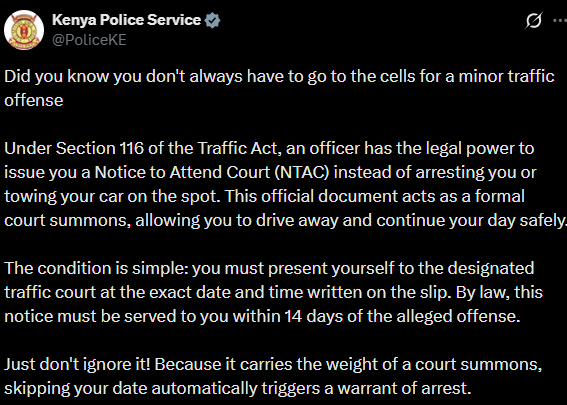
The Kenya Police Service reminded drivers about the procedure in a statement shared on its X page on Tuesday, July 7, 2026. The notice is meant to allow a driver accused of an eligible traffic offence to leave the scene and later answer the charge in court.
What the law says
Section 116 of the Traffic Act allows a police officer to serve a notice on a person reasonably suspected of committing an offence connected to the driving or use of a vehicle.
The provision applies to offences punishable by a fine, or by a fine and a prison term not exceeding six months. The notice may be served personally or sent by registered post.
It is not a verbal warning or a casual instruction. An NTAC is an official legal document that states the alleged offence and directs the motorist to attend a named court at a specific place, date and time.
The law also allows the recipient to appear through an advocate or, in some cases, enter a written plea of guilty.
Step one: Receive and read the notice carefully
A driver who is issued with an NTAC should first read every detail before leaving the scene.
Check the vehicle registration number, the alleged offence, the court named on the notice, and the date and time of appearance. It is also important to confirm that personal details have been recorded correctly.
The notice should clearly state what the driver is being required to answer in court. Keeping the document safely is important because it will be needed on the court date.
“Read the slip carefully and make sure you understand where and when you are expected to appear,” the notice stated.
Step two: Know that it does not erase the charge
Receiving an NTAC does not mean the offence has been cancelled. It simply means the matter will be handled through a court process without the driver necessarily being arrested at the roadside.
The police officer may allow the driver to continue with their journey, depending on the circumstances. However, drivers should not assume that every traffic offence qualifies for a notice or that an officer is required to issue one in all situations.

Step three: Attend court on the stated date
The most important part of the process is appearing before the court on the date written on the notice.
A driver can attend personally, appear through an advocate or use the legal option available for a written guilty plea where applicable. Missing the court date without a lawful explanation can create more serious problems than the original traffic charge.
Failure to attend may lead to the court issuing a warrant of arrest. This means a routine traffic matter can later result in arrest when the person is traced.
The 14-day requirement
The Traffic Act states that the notice should be served within 14 days from the date the alleged offence was committed.
This requirement is meant to ensure that drivers are informed of the accusation within a reasonable time. Still, drivers should seek legal guidance where they believe there is an error in the notice or where the circumstances of the case are unclear.
An NTAC is therefore not a document to ignore or throw away. It gives a motorist time to leave the roadside and prepare to answer a traffic charge properly, but it also comes with a clear responsibility: attend court as directed.