
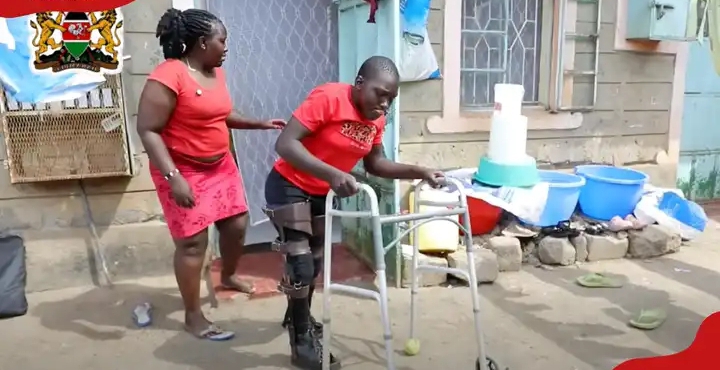
A mother from Kiambu County has shared how government financial assistance has helped her provide for her children while building a small business to support her family.
Lucy Kerubo, who cares for a young child living with a physical disability caused by cerebral palsy, said the monthly Inua Jamii payments had made a significant difference in her household.
How Kerubo used Inua Jamii cash
Kerubo revealed that she invested part of the money in starting a fish business, which has given her an additional source of income.
“Those monthly deposits have really helped because I used the cash to start a fish business,” she narrated.
The mother added that the financial support had also improved her children’s access to food, noting that they no longer went to bed hungry.
Her experience highlights how cash transfer programmes can support not only immediate household needs but also help vulnerable families establish small income-generating activities.
Kerubo praises direct mobile payments
Beyond the financial assistance, Kerubo welcomed changes in how beneficiaries receive their Inua Jamii payments.
She said receiving the money directly through mobile phones had made the process easier and reduced the additional expenses previously incurred when collecting the cash.
According to her, beneficiaries previously had to travel to financial institutions and queue to access their money, spending part of their assistance on transport.
The new arrangement has eliminated the need for such trips, allowing recipients to access their funds more conveniently.
For caregivers like Kerubo, who have responsibilities at home, the convenience of receiving money directly on their phones can also reduce the burden of leaving their dependants to collect payments.
Inua Jamii supports vulnerable families
Kerubo’s experience comes amid renewed attention on the government’s social protection programme, which targets some of the country’s most vulnerable households.
Inua Jamii has different cash transfer components, including the Cash Transfer for Persons with Severe Disabilities (PWSD), which supports extremely poor households caring for persons with severe disabilities.
The programme is designed to help caregivers meet additional expenses associated with looking after their dependants, including food, healthcare and other essential needs.
The government recently announced the release of KSh 1.69 billion for 423,520 households under the Cash Transfer for Orphans and Vulnerable Children programme.
The allocation covers the September-October 2026 payment cycle, with each eligible household set to receive KSh 4,000.
The disbursement is separate from payments under the Persons with Severe Disabilities cash transfer component.