

Citizen Digital has established that rural livelihoods and urban water security are closely linked, with farmers in vital watersheds playing a major role in protecting the quality and quantity of water flowing downstream.
The report notes that responsible land use in these areas helps sustain a significant share of Nairobi’s water supply through the Upper Tana catchment.
Nairobi’s water sources stretch far beyond the capital, into farms, riverbanks and forest edges in counties including Murang’a, Nyeri, Laikipia and Nyandarua, where smallholder farmers are increasingly embracing conservation practices that reduce erosion and limit pollution of rivers.
In Solio Village, Laikipia East, Stephen Matu and his wife Catherine Njoki say their lives changed after training linked to the Upper Tana–Nairobi Water Fund helped residents adopt rainwater harvesting and agroforestry.
Matu said he initially questioned the decision by his wife to dig a water pan on their land, only to later see it transform their dry environment into a greener settlement.
“I could go out and come back in two weeks or even monthly. One time I came back and observed a patch of our land dug into a water pan. At first I didn’t know what it was and thought it was a waste of the already limited space,” he said.
Njoki said the family once relied on donkey-supplied water, making tree planting difficult, until they began harvesting rainwater.
“I used to water seedlings with a cup of water each daily and one time it rained so much, I already had the water pan and I collected 4,000 litres of water. That was a great breakthrough,” she said.
Laikipia County extension assistant Peter Kihungi said the water being harvested is mainly surface runoff that would otherwise worsen erosion.
“The water that we encourage them to harness is majorly surface runoff. That water would otherwise have gone to waste, so we don’t reduce amount of water going to the river, but that is the water that would have otherwise exposed the land to all agents of erosion,” he said.
In Gatanga, Murang’a County, farmer Francis Mburu Waweru, 75, says he turned to agroforestry after years as a long-distance truck driver, adopting terraces and grass strips to prevent soil from being washed into nearby streams that feed tributaries of the Chania River, a key source for Nairobi’s water supply through the Sasumua Dam system.
“Water is life. It doesn’t matter how far its location. I might not be using the water direct from the source near me right now, but I have children who will find it useful sometime to come,” Mburu said.
Also in Murang’a, 32-year-old horticulture farmer John Maina says he mentors other youth on sustainable farming methods that protect rivers while keeping incomes and food security stable.
“We are also very keen to take care of our rivers. For example we devise soil blocs in the farm so that soil is not drawn down into the river,” Maina said.
Upper Tana–Nairobi Water Fund field officer Caroline Wangari said farmers are encouraged to stabilise terraces with grasses and protect riparian zones to trap soil before it reaches rivers.
“We advise them to stabilise the terraces with grasses which trap soil from the farmlands. Also along the riparian we planted grasses. Any soil that is coming from the farmlands is able to be trapped and is not going to the river,” she said.
In Laikipia, farmer Josphat Mwangi said tree planting has helped reduce strong winds and improve local conditions, with water pans supporting reforestation that also benefits downstream water flows.
“It sounds ridiculous, but we literally used to put stones in our pockets to add on weight so that we are not carried away with the wind,” Mwangi said, adding that windbreak trees have changed the local climate over time.
According to Anthony Kariuki, conservation programme manager at the Upper Tana–Nairobi Water Fund, the project is marking a decade of working with communities to conserve Nairobi’s watershed and improve water flows downstream.
“We are celebrating 10 years in 2026… with now around 260,000 farmers who are everyday working on their farms to improve their farming practices and be able to impact on reducing of degradation of the watershed,” he said.
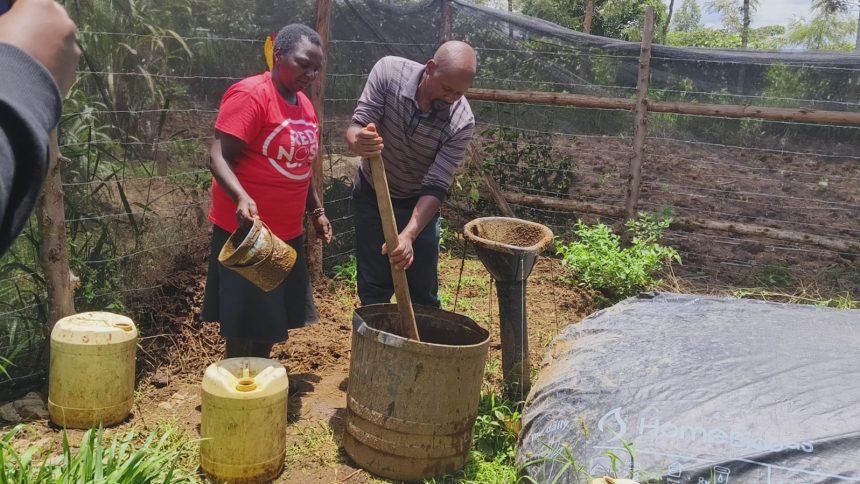
The report notes that farmers are also adopting integrated nature-based solutions such as roof gutters, water pans, agroforestry and biogas production from livestock waste, practices aimed at climate adaptation while strengthening watershed protection and improving farm productivity.