
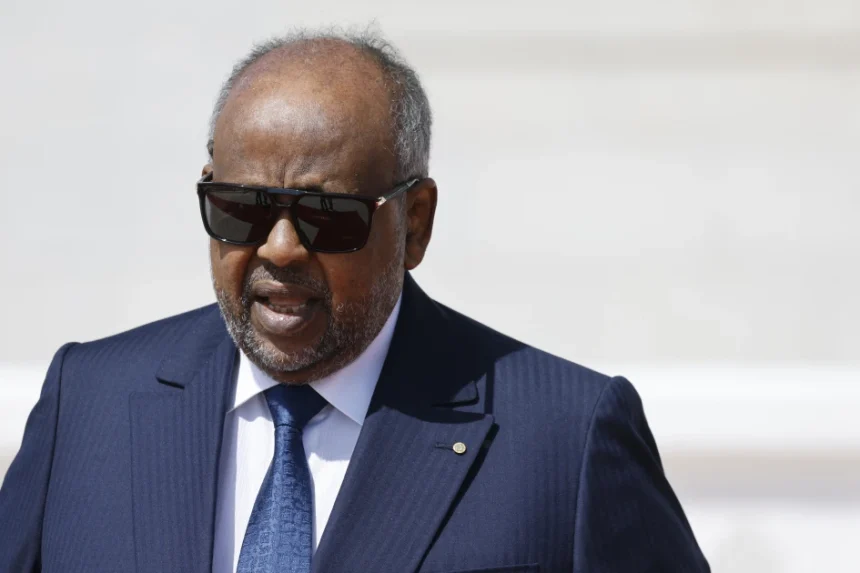
But at the age of 78, he is now running for a sixth term, arguing the need to ensure “stability” in the strategic Horn of Africa country.
Guelleh has used Djibouti’s unique position between Africa and the Arabian Peninsula to attract investors and foreign military powers, while keeping a tight grip on power.
The portly polyglot with a salt and pepper beard has ruled since 1999 and most Djiboutians just refer to him by his initials, IOG.
“No, no and no, three times over,” the head of state insisted in 2022.
At the time, the constitution set a 75-year-old age limit for presidential candidates.
But in November, parliament voted to remove the age limit, opening the way for Guelleh to extend his 27 years in power.
“He had decided not to run again and it was very difficult to convince him to change his mind,” Dileita Mohamed Dileita, the speaker of parliament, told AFP.
“But with the situation in the Middle East and the war on our doorstep on the other side of the Red Sea, we need stability,” said Dileita, who was Guelleh’s prime minister for 12 years.
Sonia le Gouriellec, a Horn of Africa specialist at the Catholic University of Lille, called the argument “an excuse”.
“No successor seems to be emerging to take his place,” she said.
“The names that have circulated were quickly dismissed.”
Polyglot
Guelleh was the handpicked successor to his relative Hassan Gouled Aptidon, the first president after Djibouti’s independence from France in 1977.
Born in 1947 in neighbouring Ethiopia, where his father was a railway worker, Guelleh came to Djibouti as a teenager, later joining the police.
He quickly rose to become Aptidon’s chief of staff, a powerful role that he held for 22 years.
He also supervised security forces and the intelligence services.
In 1999, Aptidon stepped down, passing the torch to Guelleh, who was elected without difficulty.
He speaks six languages — Amharic, Arabic, English, French, Italian and Somali.
Since his earliest years in power, Guelleh has seized on Djibouti’s unique location on the Red Sea to develop the tiny, arid nation of one million into a reliable international military and maritime hub.
The third-smallest country by area on the African mainland, and sandwiched between volatile neighbours, Djibouti embarked on an infrastructure blitz, courting major investment in its quest to become the “Dubai of Africa”.
It also hosts military bases for global powers including France, the United States, Japan and China.
– International standing –
Guelleh relies on both his sub-clan, the Mamasan, and his extended family to control the levers of power.
“There is a total lack of preparation” for the post-IOG period, said a Djiboutian political researcher who requested anonymity.
However, the researcher told AFP that Guelleh had done a “good job in foreign policy”.
One of Guelleh’s closest loyalists, Mahamoud Ali Youssouf, who served as foreign affairs minister for nearly 20 years, was elected to head the African Union Commission last year.
Despite the president’s international standing and a plethora of infrastructure projects, largely financed with massive loans from China, many Djiboutians remain in grinding poverty.
Guelleh’s government has also been accused by rights groups of cracking down on dissent, limiting free speech and suppressing opposition parties.
Asked whether his sixth term would be his last, researchers and diplomats said it depended on the health of the president, who has difficulty walking, and on the growing influence of his wife, Kadra Mahamoud Haid.
Le Gouriellec said a key factor would be finding a figure backed by all the sub-clans and by the need to prevent internal instability “at all costs”.