


More women than men are paying bribes to access birth and death certificates.
This is according to the Kenya Gender and Corruption Surveyreleased on Thursday, April 9, 2026, by the Ethics and Anti-Corruption Commission (EACC) through the EU-funded Programme for Legal Empowerment and Aid Delivery (PLEAD II) and in partnership with UNODC, KNBS, NGEC, Transparency International Kenya,
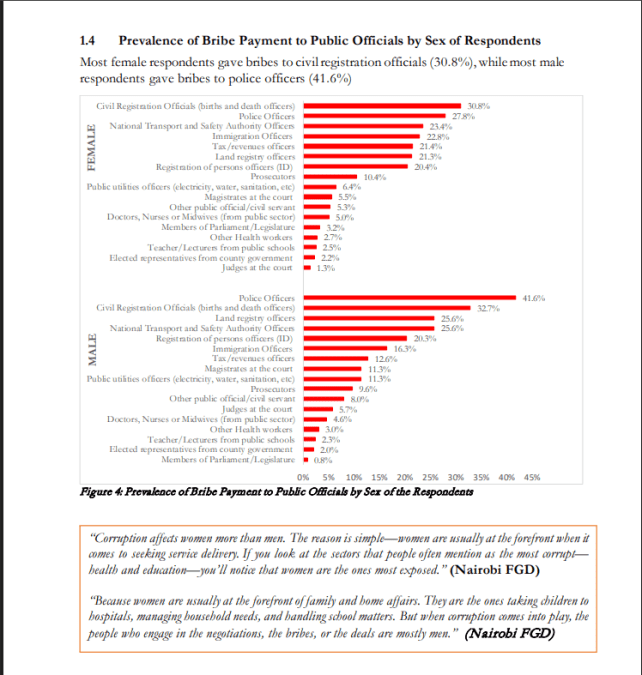
The report shows that 30.8 per cent of female respondents who admitted to paying bribes did so to civil registration officials, including birth and death officers, making it the leading point of bribery among women.
In contrast, 41.6 per cent of male respondents reported paying bribes mainly to police officers, highlighting law enforcement as the most common point of corruption among men.
“Most female respondents gave bribes to civil registration officials (30.8%), while most male respondents gave bribes to police officers (41.6%),” the Kenya Gender and Corruption Survey 2025 reads.

Where women are paying bribes
Beyond civil registration services, women reported giving bribes across several public institutions.
These include police officers, National Transport and Safety Authority (NTSA) officials, immigration officers, and tax or revenue officers.
“Civil Registration Officials (births and death officers) ,Police Officers, National Transport and Safety Authority Officers, Immigration Officers, and Tax/Revenue Officers”, the survey reads.
Other areas mentioned include land registry offices, registration of persons (ID services), prosecutors, and public utilities such as electricity, water, and sanitation providers.
“Land registry officers, Registration of persons officers (ID) ,Prosecutors and Public utilities officers (electricity, water, sanitation, etc.),” the survey reads.
Women also cited bribery cases involving magistrates, healthcare workers such as doctors, nurses and midwives; as well as teachers and lecturers in public institutions.
Where men are paying bribes
For men, police officers ranked highest, followed by civil registration officials and land registry officers. NTSA officials, registration of persons offices, and immigration officers also featured prominently.
Additional areas included tax and revenue offices, magistrates, public utilities, and prosecutors.
Similar to women, men also reported bribery cases involving healthcare workers, teachers, and elected leaders at both national and county levels.
Gendered pattern in access to services
The findings reveal a clear gender pattern in interactions with public services. Women are more affected when accessing essential civil services such as birth and death registration, while men are more likely to encounter bribery in policing.
The report also underscores the urgent need for reforms in key sectors, especially civil registration and law enforcement, to curb corruption and improve transparency.