

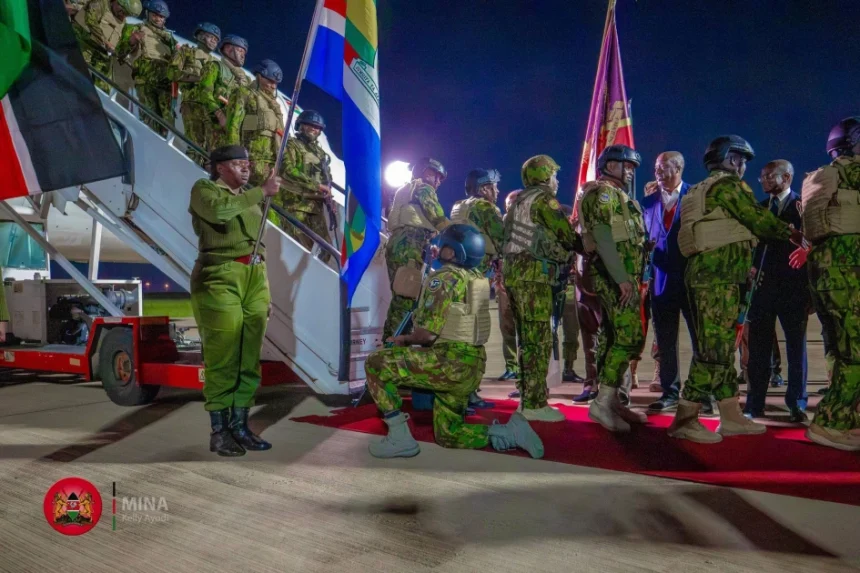
The last consignment of Kenyan police officers who were on a mission to restore peace in the Caribbean nation is expected to return home soon.
In a video seen by Citizen Digital, the civilians blocked the movement of Kenyan officers to St. Marks and Pont Sonde, protesting their planned departure.
Helicopters were used to carry the officers out of Petite Rivière and Pont Sonde as protesters barricaded roads to block the Kenyan police officers from leaving.
The exit of the Kenyan troops gives room for the Gang Suppression Force (GSF), approved by the United Nations Security Council in October 2025.
The new GSF will be led by Chadian forces. The first batch of Chadian police arrived in Haiti early April for the peace operation.
Jack Christofides, a South African U.N. official will lead the GSF mission, taking over from Kenya’s Godfrey Otunge, who led the MSS mission.
Christofides, who has overseen various peacekeeping operations in Africa, was appointed as Special Representative of the GSF late last year.
State broadcaster IRIB on Sunday cited Iranian sources as saying “there are currently no plans to participate in the next round of Iran-US talks”.
The Fars and Tasnim news agencies had earlier cited anonymous sources as saying “the overall atmosphere cannot be assessed as very positive”, adding that lifting the US blockade was a precondition for negotiations.
State-run IRNA meanwhile pointed to the blockade and Washington’s “unreasonable and unrealistic demands”, saying that “in these circumstances, there is no clear prospect of fruitful negotiations”.
Iran and the United States, along with Israel, are just days away from the end of the two-week ceasefire that halted the Middle East war, ignited by surprise US-Israeli strikes on Iran on February 28.
There has so far been only a single, 21-hour negotiating session held in Islamabad on April 11 that ended inconclusively, though groundwork for fresh talks continued afterwards.
“We’re offering a very fair and reasonable DEAL, and I hope they take it,” Trump said in a post on Sunday, while also renewing his threats against Iran’s infrastructure if a deal is not made.
US fires on Iranian ship
Trump has been under pressure to find an off-ramp since Tehran moved early in the war to choke off the Strait of Hormuz.
The vital waterway is a conduit for a fifth of the world’s oil and liquefied natural gas in peacetime, and its closure has hammered the global economy and roiled markets.
Having failed to force it open again, Trump countered with a US naval blockade on Iranian ports in an attempt to cut off Tehran’s oil revenues.
On Sunday, he announced that a massive Iranian-flagged cargo ship “tried to get past our Naval Blockade, and it did not go well for them.”
A US destroyer warned the ship to stop and then forced it to by “by blowing a hole in the engineroom”, Trump said, adding: “Right now, U.S. Marines have custody of the vessel.”
Trump said the Iranian-flagged ship, Touska, is under US Treasury sanctions “because of prior history of illegal activity.”
The ISNA news agency later cited a spokesperson for Iran’s central command centre as warning that “the armed forces of the Islamic Republic of Iran will soon respond and retaliate against this armed piracy and the US military”.
Tasnim news agency reported Tehran had sent drones in the direction of US military ships after it “attacked” and seized Touska.
Iran had briefly reopened the strait on Friday in recognition of an Israel-Hezbollah ceasefire in Lebanon, but closed it again the following day in response to the United States maintaining its blockade.
Iran’s Revolutionary Guards warned that any attempt to pass through the strait without permission “will be considered cooperation with the enemy, and the offending vessel will be targeted”.
Iranian foreign ministry spokesman Esmaeil Baqaei on Sunday said the blockade was “a violation” of the ceasefire and illegal collective punishment of the Iranian people.
A handful of oil and gas tankers had crossed the strait early on Saturday during the brief reopening, but by early Sunday morning tracking data showed the waterway empty of shipping.
The afternoon before, a trio of incidents involving Iranian fire and threats towards commercial vessels demonstrated the danger of any attempted crossing.
Heightened security
In spite of the uncertainty surrounding the talks in Pakistan, security was visibly stepped up in Islamabad on Sunday in anticipation of the negotiations.
Authorities announced road closures and traffic restrictions across the city, as well as in neighboring Rawalpindi.
The US president said his negotiators, whom he did not name, would arrive in the Pakistani capital on Monday evening.
A White House official said the delegation would be led by Vice President JD Vance and include Middle East envoy Steve Witkoff and Trump’s son-in-law Jared Kushner.
A major issue in the negotiations has been Iran’s stockpile of near-weapons-grade enriched uranium.
Trump said on Friday that Iran had agreed to hand over its roughly 440 kilograms (970 pounds) of enriched uranium. “We’re going to get it by going in with Iran, with lots of excavators,” he said.
But Iran’s foreign ministry has said the stockpile, thought to be buried deep under rubble from US bombing in last June’s 12-day war, was “not going to be transferred anywhere”, and surrendering it “to the US has never been raised in negotiations.”