


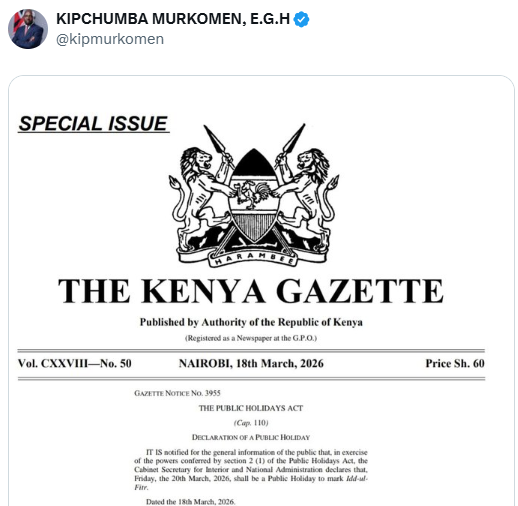
Interior and National Administration Cabinet Secretary (CS) Kipchumba Murkomen has officially declared Friday, March 20, 2026, a public holiday to mark Eid al-Fitr.
According to a gazette notice issued on Wednesday, March 18, 2026, he stated that the declaration was made in exercise of the powers conferred by Section 2(1) of the Act.
“IT IS notified for the general information of the public that, in exercise of the powers conferred by section 2 (1) of the Public Holidays Act, the Cabinet Secretary for Interior and National Administration declares that, Friday, the 20th March, 2026, shall be a public holiday to mark Idd-ul-Fitr.”
Idd-ul-Fitr is a significant Islamic celebration marking the end of Ramadan, the holy month of fasting. The day is traditionally observed with prayers, feasting, charity, and family gatherings.
The start of the Lenten period (Ash Wednesday) coincided with the start of Ramadhan approximately every 33 years because the Islamic lunar calendar shifts through the Gregorian calendar.
This year, 2026, both Ash Wednesday (the start of Lent) and the beginning of Ramadan was on February 17, 2026. In the year 1992, Ramadan began on or around March 7, overlapping with the Lenten period.
During Lent, many Christians worldwide observe six weeks of fasting, abstinence, and almsgiving before Easter. Although this observance is predominantly a Roman Catholic and Eastern Orthodox practice, Christians of all denominations can and do observe Lent to prepare the soul, mind, and body for the celebration of Christ’s resurrection on Easter Sunday.
Dating back to at least the fourth century and known in Greek as ‘Tessarakosti’ and in Latin as ‘Quadragesima’, Lent is marked on the liturgical calendar, beginning on Ash Wednesday and culminating on the Saturday before Easter. This equates to a total of forty days, not including Sundays therein.
In Lent, Christians imitate Jesus’ 40-day fast in the desert, focusing on soul-searching or examination of conscience, repentance, self-discipline, and spiritual renewal.
On the other hand, within Islam, Ramadan is considered one of the holiest periods of the year for Muslims. In the month of Ramadhan, Muslims commemorate the revelation of the Qur’an, and fast from food and drink during the sunlit hours as a means of drawing closer to God and cultivating self-control, gratitude, and compassion for those less fortunate.
Ramadhan, therefore, is a month of intense spiritual rejuvenation and devotion, as Muslims spend extra time reading the Qur’an and performing special prayers. Those unable to fast, due to age or health matters, are exempt from fasting.