

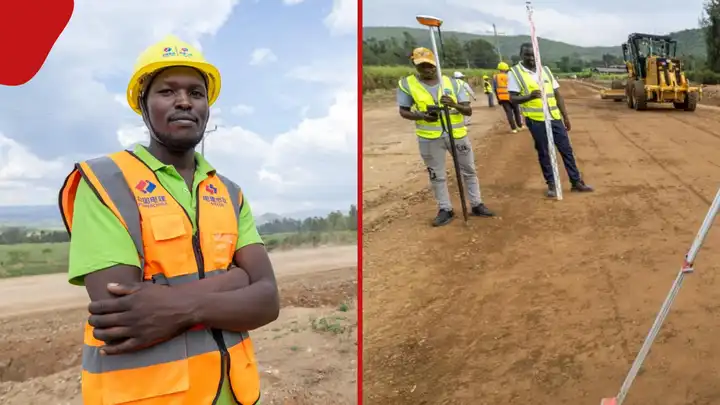
Victor Kipkosgei arrived at the Timboroa-Meteitei-Kopere Road construction site with nothing to his name in the way of livestock. Months later, the Taptengelei resident in Nandi County has used his wages to purchase nearly two cows, a meaningful asset in a rural household where livestock signals economic stability.
“I did not have any cows before joining this project, but through the income I have earned, I have managed to buy almost two. I am grateful for the opportunity,” Kipkosgei told Newsunplug.co.ke
His story is one of several emerging from a road project that has quietly become a lifeline for communities living along the construction corridor.
How the Road Project Is Changing Lives
The 63.2-kilometre route is being upgraded from gravel to bitumen standard, and construction has recorded 80% physical progress, with roughly 46 kilometres already completed.
Around 200 technical and casual workers have been engaged since works began, drawing from surrounding communities and channelling income back into local households.
Mercy Chepkemoi, who works as a laboratory attendant on the project, has spent close to two years collecting construction materials, running laboratory tests and reporting results to verify that materials meet engineering specifications.
Over that period, her role has expanded well beyond the laboratory bench. She has picked up skills in operating heavy equipment such as rollers and gained experience working in a team environment.
Chepkemoi notes that the project has opened doors for young people who never advanced to college, giving them a setting to discover practical abilities and gain exposure to real workplace demands.
Workers Reinvest Earnings in Their Families
For Samuel Karanja, who hails from the Timboroa area, the income has meant being able to meet school fees and cover day-to-day household needs for his children. Several other workers echo similar sentiments, pointing to the project as a buffer against unemployment in an area where formal job opportunities are limited.
The project engineer confirmed that recruitment has been deliberate in drawing workers from communities along the route, with the aim of ensuring that economic benefits remain within those localities as construction progresses.
For Kipkosgei, the two cows he has worked towards purchasing carry significance that goes beyond their market value.
They represent the kind of tangible, lasting gain that a temporary construction contract can produce when wages are directed wisely, and they offer a concrete illustration of how infrastructure investment can ripple outward into individual lives and family wellbeing.