

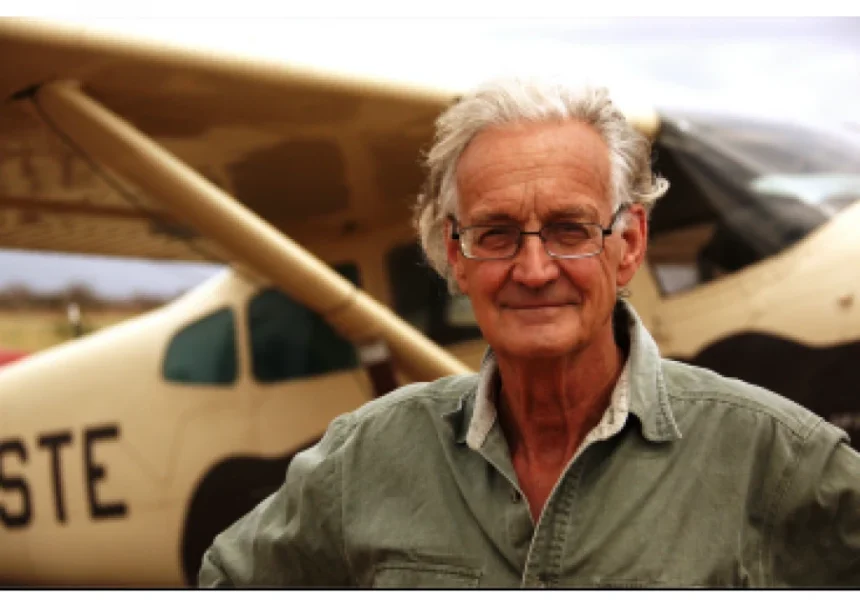
Widely regarded as one of the most influential figures in modern wildlife conservation, Douglas-Hamilton devoted more than six decades to studying and safeguarding African elephants.
His pioneering research and tireless advocacy helped reshape global understanding of elephant behaviour and drove international action to curb ivory poaching.
Douglas-Hamilton completed the first scientific study of wild elephant social structures at age 23, work that laid the foundation for contemporary elephant behavioural science.
As poaching intensified in the decades that followed, he evolved from researcher to outspoken advocate, documenting the crisis with a level of detail that revealed the scale of the slaughter—more than half of Africa’s elephants killed within ten years.
His findings were instrumental in the 1989 global ban on the international ivory trade.
In 1993, he founded Save the Elephants, a conservation organisation focused on protecting elephant habitats, promoting coexistence with local communities, and deepening global appreciation for the species’ intelligence and social complexity.
His early adoption of GPS tracking and aerial survey methods revolutionised elephant monitoring and set new standards for wildlife protection worldwide.
Douglas-Hamilton again emerged as a leading global voice during the 2010–2012 poaching surge, which claimed an estimated 100,000 elephants.
He testified before the U.S. Senate Committee on Foreign Relations in 2012, advocating for stronger international action—a campaign that contributed to the closure of domestic ivory markets worldwide, including China’s in 2018.
In 2013, he co-founded the Elephant Crisis Fund with the Wildlife Conservation Network to support frontline conservation initiatives.
By 2025, the Fund had supported more than 120 organisations in 44 countries, directing over $40 million to more than 500 projects aimed at stopping poaching and improving human-elephant coexistence.
Douglas-Hamilton’s influence extended into books and film. With his wife, Oria, he co-authored the acclaimed works Among the Elephants (1975) and Battle for the Elephants (1992).
His research and conservation efforts featured in numerous documentaries, including The Secret Life of Elephants (BBC, 2008) and A Life Among Elephants (Maramedia, 2024).
He received numerous honours throughout his life, among them the Order of the Golden Ark (1988), an OBE (1992), the Indianapolis Prize (2010), a CBE (2015), and the Esmond B. Martin Royal Geographical Society Prize (2025).
Whether sitting quietly among elephants, poring over maps of their movements or circling above a herd in his beloved aircraft, that glint in his eye was always there. He never lost his lifelong curiosity about the minds of one of our planet’s most intriguing creatures.”