

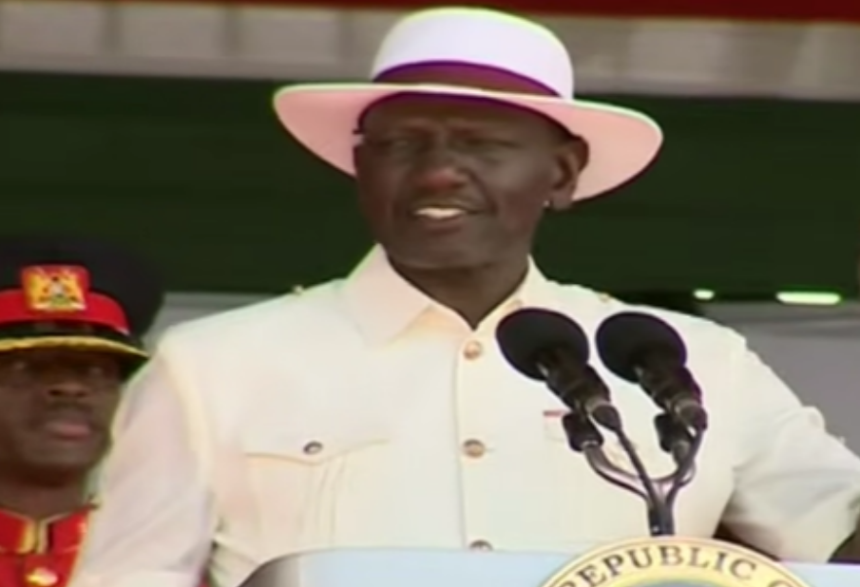
President William Ruto has issued an apology to the people of northern Kenya for what he described as decades of systemic exclusion, neglect, and unequal development by successive governments.
Speaking on Monday, June 1, 2026, at the Wajir County Stadium in Wajir County during the Madaraka Day celebrations, the President said the State had for years failed to fully integrate the region into national development planning.
“Poleni sana ndugu zetu.It was never meant to be this way. This has been a very emotional moment for me,” the President expressed.
He said the decision to host the national celebrations in Wajir was deliberate and meant to reflect a shift in how national events and development priorities are shared across the country.
“This is what we meant when we said we will leave no one behind,” he said. “For the first time in 63 years of self-rule, a national celebration is being hosted here in Wajir, in the heart of northern Kenya.”
Ruto said the occasion went beyond ceremony, describing it as a statement of recognition and belonging for communities that have long felt left out of national progress.
“It is not a mere ceremonial gesture, it is a national declaration, it is a moment of affirmation that Madaraka, our freedom, our dignity, our self-determination was never meant for some Kenyans, never meant for some region and withheld for others,” he added.
He also challenged the long-standing narrative that northern Kenya is too remote, too dry, or too insecure to justify major development investments, saying such thinking had contributed to inequality.
“For too long some said the region was too difficult, too remote, too dry, and too insecure to deserve any development. That was wrong then, it is wrong now, and it will forever remain wrong,” the President said.
Northern Kenya, which broadly includes counties such as Wajir, Mandera, Garissa, Marsabit, Isiolo, Turkana, Samburu, and parts of Laikipia and Tana River, covers a large share of Kenya’s landmass but remains one of the least densely populated regions in the country.
The area is largely arid and semi-arid, with livelihoods mainly centred on pastoralism, small-scale trade, and cross-border commerce. It has historically faced challenges, including recurrent droughts, limited road infrastructure, low access to water and health services, and long distances between settlements.