

It was about learning how to keep a child alive while watching the illness slowly interfere with the life he was supposed to build.
There were emergency-room visits. There was pain. There were crises triggered not only by physical strain, but sometimes even by stress and excitement.
A holiday could become a source of anxiety.
A planned trip could be kept secret until the last moment because anticipation itself could push her son into a crisis.
“We figured out how to live with him,” Rae Blaylark recalls, describing years spent learning how to navigate a condition that could disrupt ordinary family life.
But the physical pain was only part of the story.
As her son grew older, sickle cell began reaching into other parts of his life.
His education was interrupted. His working life was affected. His college career lasted less than a year before a medical crisis left him in a coma.
And gradually, his mental health suffered.
As a young boy, he once watched a cartoon in which a character wished he could have no feelings.
He decided he could do the same.
He tried to shut his emotions away.
Years later, his mother asked whether he had watched the cartoon until the end, when the character regained his feelings.
He had.
But he had not paid attention to that part.
He had only wanted to get rid of his emotions.
For Rae, the consequences were profound.
Sickle cell, she says, had not only brought physical pain. It had “stolen the joy of living” and the opportunity to dream.
That is where the story of sickle cell changes.
It is no longer only about the number of crises a patient experiences or the pain they endure.
It becomes a question of what happens to a person’s education, employment, relationships, mental health and sense of possibility when chronic illness repeatedly interrupts their life.
For years, Rae became her son’s advocate.
She learned to question the healthcare system and demand explanations when she did not understand what was happening.
At one point, she questioned why nurses needed to wake her son at 3 a.m. to take his blood pressure after he had finally managed to sleep.
When she could not get an answer, she kept asking and moved up the chain until someone could explain.
For Rae, understanding the system was part of caring for her son.
But advocacy was not only about challenging healthcare providers.
It was also about making sure her son did not lose his own voice.
“I cannot be his voice, but I can be his advocate,” she says.
She wanted him to understand that his voice mattered, even when it shook.
She wanted healthcare workers to see him not simply as a patient in pain, but as a person with dreams, fears, opinions and a future.
That distinction became increasingly important as his mental health deteriorated.
Rae eventually sought counselling for him.
It was not always easy. Sometimes she had to persuade him to go.
But she recognised that being his mother was not enough.
He needed other people who could support him — a counsellor, a pastor, an uncle and others who could provide different forms of support.
Chronic illness was affecting not only his body, but also his ability to imagine and pursue a future.
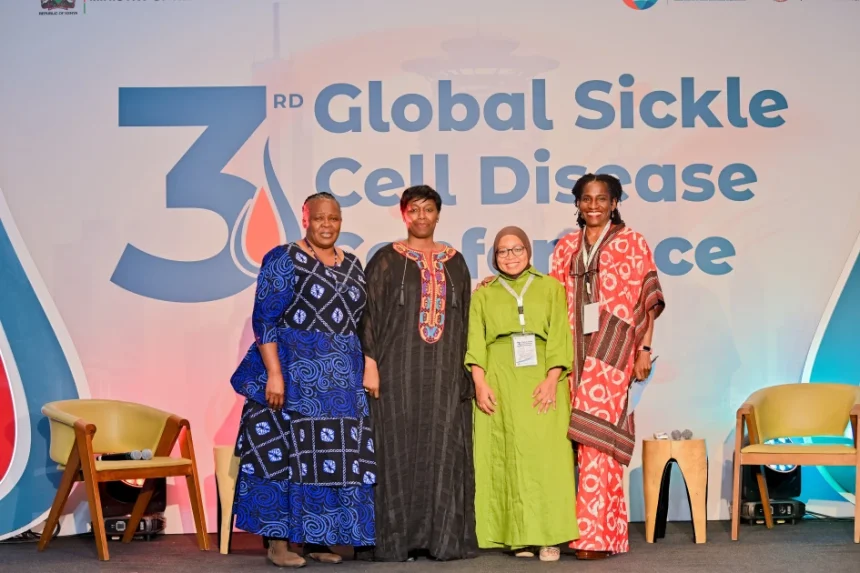
Rae’s experience is echoed by another mother and advocate, Selina Ogweno.
Selina describes herself simply:
“I’m a mother first.”
But her journey has taken her far beyond motherhood.
She entered the world of sickle cell advocacy in 2005 without fully understanding what the condition meant. By 2007, she had left her career in IT and committed herself to the journey of supporting people living with sickle cell.
Today, she describes herself as an advocate and a mother to many.
Her experience began with her own son’s diagnosis.
She remembers the moment clearly.
Her first thought was that her child was going to die. Then she met Dr Casey Hoffman.
Her first question was not about medication or treatment.
It was about the future.
“Will I be a grandmother? Will I be able to see my grandchildren?”
The doctor laughed and reassured her.
“Yes, why not?”
That answer gave her something to hold on to.
She left her IT job and immersed herself in caring for her son.
The early years involved constant supervision regular check-ups, hydration and reminders about how he needed to behave.
She even diluted his soda with water.
But as he became a teenager, he began asserting himself.
Selina realised she could not control every decision he made.
She also realised that many parents make the mistake of expecting their children simply to obey.
She had to learn that she was raising an individual who would eventually have to take responsibility for his own health.
At school, she worked with teachers and staff to ensure they understood his condition. Even the school janitor knew about his sickle cell disease.
She gave the school the doctor’s number and instructed them to call the doctor and then call her whenever her son felt unwell.
But eventually, the boy she had spent years protecting became a young man capable of managing his own life.
He attended boarding school without experiencing a crisis.
He went through COVID-19 without a sickle cell crisis.
He joined university.
He began going out with friends and returning home in the morning living much like other young people his age.
For Selina, that was a victory.
Then, after years without a crisis, he experienced his first major one in May 2026.
“We were crushed, we did not know what to do, Selina says.
But we also realised how far he had come.
He was no longer the small boy whose mother had to monitor every glass of water and every decision.
He was a grown man.
Selina says, people living with sickle cell are not defined by their condition.
They grow up, make choices, fall in love, pursue careers, make mistakes and have ambitions.
They become parents and grow old.
The stories of Rae and Selina therefore raise a bigger question about what it means to care for someone with a chronic illness.
Is healthcare only helping people survive the next crisis?
Or is it helping them build a life beyond the crisis?
For someone living with sickle cell, survival can mean getting through another painful episode, another emergency-room visit or another hospital admission.
But living means something more.
It means being able to go to school, work, make plans, travel and live life.
And to receive care for the mind as well as the body.
Rae sums up another lesson from her years of advocacy through a philosophy she calls
E + R = O – Event plus Response equals Outcome.
The event may not always be within a person’s control.
The response can be.
For families living with sickle cell, that response may mean asking difficult questions, seeking appropriate treatment, supporting mental health, advocating for better care and, eventually, allowing the person living with the condition to take ownership of their own life.
Because a person can survive a crisis and still lose a piece of their education.
Survive the pain and lose a job.
Survive the hospitalisation and withdraw from the world.
Survive physically while struggling emotionally.
The challenge for healthcare is therefore bigger than keeping patients alive.
It is ensuring that, after surviving, they still have the opportunity to live.