

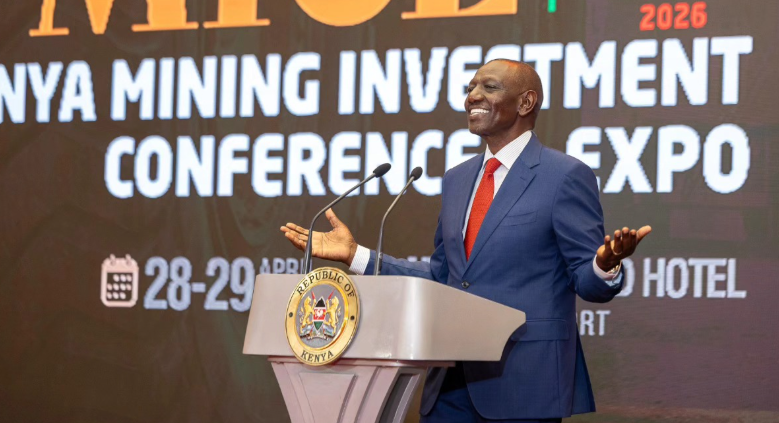
President William Ruto has defended remarks he made about Nigerian-accented English, which went viral online, saying the comments were taken out of context and were meant as light-hearted humour during a broader discussion on communication in Africa.
Addressing the backlash while speaking at the Mining Investment Conference and Expo in Nairobi on Tuesday, April 28, 2026, where Nigeria’s Minister of Solid Minerals Development, Ele Alake, was in attendance, Ruto said his comments had been misinterpreted after circulating online without full context.
Ruto explained that the comments were made in an informal setting while speaking with Kenyans abroad in Italy.
He said he was referring generally to differences in English accents across Africa and jokingly suggested that, in some cases, understanding certain variations could require a “translator.”
“The facts are that I was talking about how we in Africa speak very good English, all of us,” Ruto said. “In fact, in some countries like Nigeria… if you don’t speak excellent English, like the one we speak in Kenya, you may need a translator.”
Nigeria as in-laws remark
Ruto also used the opportunity to reaffirm relations with Nigeria, referring to President Bola Tinubu as a friend and describing Nigerians as his “in-laws.”
“My in-laws, I hope there will be no consequences for whatever was done,” he added, drawing laughter from the audience.

He further downplayed the backlash with a light remark, saying the comments had been taken out of context after being shared online.
The President maintained that the remarks were not intended to offend and insisted they were part of informal humour during diplomatic engagement.
He said the remarks were recorded and circulated without context, which led to misunderstanding and unnecessary backlash.
The original comments sparked debate on social media, with many Nigerians viewing them as mocking, while others saw them as typical African banter between two leaders whose countries often engage in friendly rivalry.